When Yong Quan Tan graduated from college in 2023, he still considered himself a “traditional software engineer.”
Playing with OpenAI’s GPT -4, which came out in March, he worried that his developer skills wouldn’t be enough to get or keep a job in tech.
“I panicked. I thought, OK, I have to go to AI events because I have no idea what’s going on,” he said. “It feels like the asteroid is going to hit the dinosaurs soon.”
He started looking for a place to find out what was going on. In Singapore, where he is based, there wasn’t much of an AI scene.
Although Singapore is home to thousands of tech startups, according to the AI builders Business Insider spoke to, it lacked the developer culture associated with hubs like San Francisco, Tel Aviv and Bengaluru that produced “cracked” engineers – jargon for exceptionally talented programmers.
AI has changed that dramatically.
Over the past two years, a collection of grassroots organisers, hackathons and builder communities have made Singapore an unlikely hotbed for people looking to create software. Vibe coding – the use of natural language to get AI to write software – has reduced the mental and financial costs of building and given virtually everyone a ticket to the AI boom.
That momentum has given AI giants like OpenAI and Anthropic, and scale-ups like Cursor and Cognition, an incentive to set up Asia-Pacific headquarters in Singapore, creating hundreds of technical and non-technical jobs.
No presentation slides
For Tan, the turning point came in late 2024, when he came across the Singapore chapter of AI Tinkerers, a San Francisco-based group that organizes AI meetups.
The format was deliberately different from the buttoned-down technical events he was used to. Builders showed each other how they used the latest AI models to build tools for their daily lives. Rough projects with errors were welcome, but presentation slides were not.
Tan was hooked. When Henry Mao, the founder of the Singapore chapter of AI Tinkerers, wanted to quit to work on his startup full-time, Tan kept asking to take over.
“Henry was like, I’ve never seen anyone so persistent. OK, you got it, man,” Tan said, adding that he had taken over the group last year.
Tan presents at a construction meeting in Singapore. Yong Quan Tan
AI Tinkerers Singapore, now called Natives, organizes demo evenings, workshops and hackathons targeting everything from voting agents to agentic workflows. The events regularly attract more than 100 people – a number that Tan says is limited by venue constraints rather than applicant interest.
“We were just organizing events, but then suddenly people started feeling like this could be something they were part of, something they belonged to,” Tan said.
He said two attendees met through the community and co-founded an agent AI startup.
The comeback story
AI Tinkerers wasn’t the only group to notice the hunger to bring back tech-focused conversations and community.
Before the pandemic, Singapore had a vibrant, well-established tech and hackathon scene, centered around startup incubators like BLOCK71 and heavily supported by universities, government agencies and companies like Grab and Amazon. Hackathons in consumer tech, blockchain and smart-city technology routinely attracted hundreds of builders before the scene dwindled during and post-COVID.
65labs, a Singapore-based construction collective, entered 2025 with the philosophy of hosting events designed to send home visitors looking to make something.
Are Cursor hackathon in October received more than 1,000 registrations and brought hundreds of builders together for 24 hours. Participants submitted nearly 150 working products, including an AI “aunt” that reminds you to take your meds with humor, and a LinkedIn-based dating app that could help you check your compatibility with AMD’s Lisa Su. 10 sponsors have committed more than $400,000 in resources and support to winning teams.
The robot demonstration room at AIE Singapore 2026. Yong Quan Tan
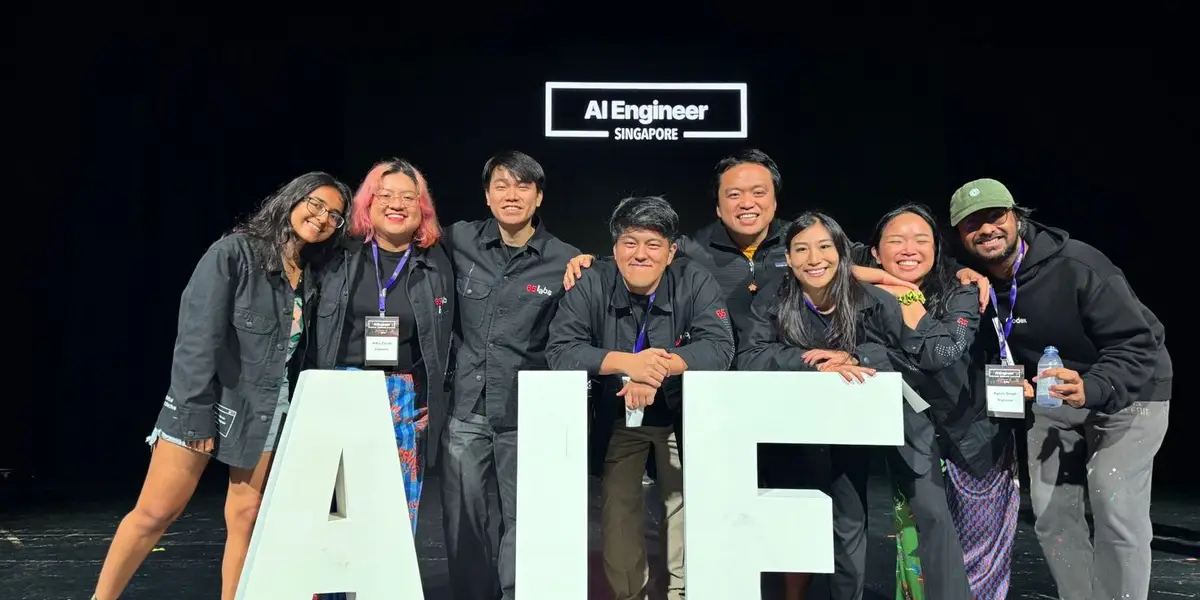
By May 2026, 65labs had helped bring AI Engineer’s first Asian conference to Singapore. More than 1,000 people attended the three-day conference, supported by companies including OpenAI, Google DeepMind, Cursor, Vercel, Cloudflare and Stripe. The 92-person speaker list was filled with founders and experts from the world’s largest AI companies who flew 16 hours from San Francisco to demonstrate what they’re building with AI.
A surprising addition to the list was Singaporean Foreign Minister Vivian Balakrishnan, who shared how he uses NanoClaw agents and how he himself is a “geek” and “tinkerer”. Built as a more secure alternative to OpenClaw, NanoClaw agents are lightweight, open-source personal AI assistants that can perform tasks such as replying to emails or sorting photos.
A common takeaway from the explosion of X and LinkedIn posts that followed the conference was: don’t dismiss Singapore as an AI hub; things are just getting started.
Rise of the non-technical founder
For Nehal Agrawal, who discommunicates AI Engineer, the most important part of that recent boom isn’t just that Singapore has more AI events: it’s about who feels like they belong.
When Agrawal graduated in 2024 as a business administration major, AI was synonymous with ChatGPT for her. She said people in research or engineering started learning how to use AI, but as a non-technical person, AI felt “closed off.”
Vibe coding blew a hole through that port.
A speaker who organizes AI workshops at AIE Singapore. AI engineer Singapore
At a construction event she attended in early 2026, Agrawal said about 1,000 people showed up on Monday evening, ranging from 18-year-olds to people in their 80s.
It’s not just fitness trackers and browser games; vibe coding has changed who a founder can be. At AI Engineer Singapore, there was a high concentration of non-technical founders who had taught themselves how to use Claude Code, Codex or Cursor to launch and scale their startups.
“Suddenly people around me are talking about assessments, harnesses, loops and context, and these are all non-technical people,” Agrawal said.
For her, being AI-native doesn’t mean that you can suddenly write thousands of lines of Python. It’s about controlling models, testing their results, and putting tools together for your personal projects. work or part-time jobs.
Agrawal, who now shares AI workflows and automations she built on her own website, said vibe-coding changed her perception of what she could create.
“It broke down a lot of psychological barriers to your own strengths or to your own ability to learn,” she said.