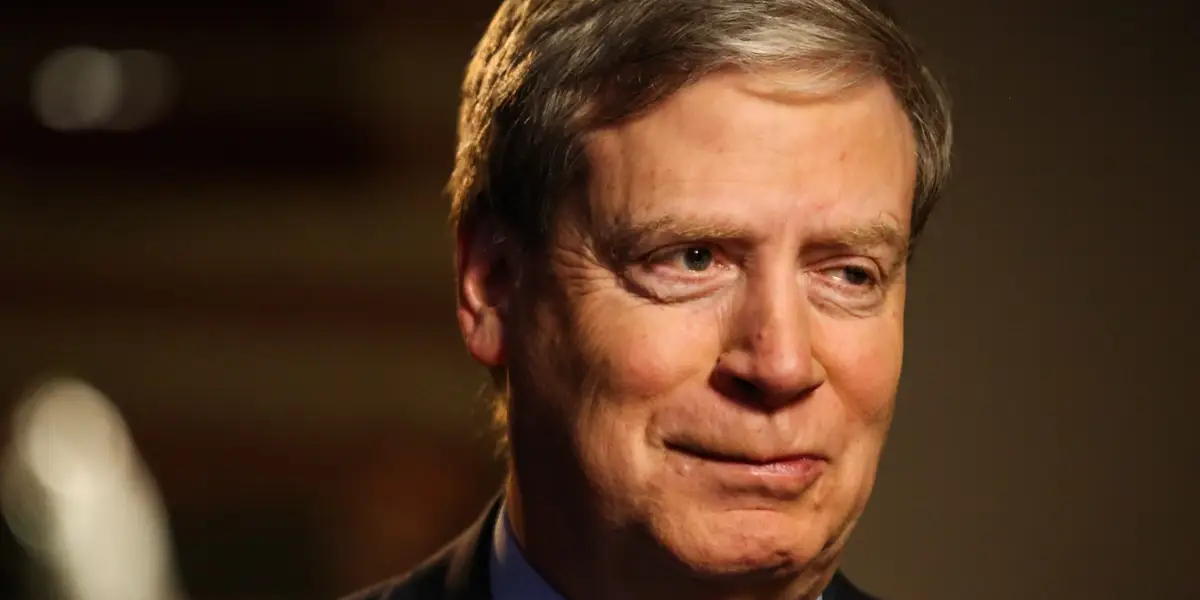
When Stanley Druckenmiller speaks, the markets listen. When the legendary trader uses AI to formulate his message, investors can’t stop talking.
Druckenmiller has said he used AI to write his viral op-ed in the Wall Street Journal this week. In the piece he criticized Scott Bessent, the head of the US Treasury Department and his former protégé, for stepping up bond buybacks in an effort to drive down Treasury yields.
The billionaire investor — who worked with Bessent at George Soros’ hedge fund and Fed Chairman Kevin Warsh at Duquesne Family Office — told the Journal that at age 73, he felt “a little proud” of using AI tools like Claude and ChatGPT, which he likened to using a calculator or a speechwriter.
Druckenmiller said he was much better at economics than writing, and defended the op-ed as representative of his views.
‘These are my ideas and that is what I did talk about them for more than fifteen years, as anyone who knows me knows,” he said.
Paul Gigot, the Journal’s editorial page editor, said in a statement in his own publication that “AI is a fact of modern life” and “no one can doubt that his op-ed is his honest opinion.”
Druckenmiller and The Wall Street Journal did not immediately respond to requests for comment from Business Insider.
Splitting the street
The revelation of the market wizard has divided financial commentators over X. Some argued that he should have disclosed his use of AI, and that this detracted from the value of his latest message. Others said it’s Druckenmiller’s ideas that count, and AI writing new normal.
John Huber, the founder of Saber Capital Management, said in an X post that some people “consider AI writing a form of plagiarism” or “at the very least dishonest.”
Huber added that, especially in the case of an op-ed, if the “words are not authentic, they lose at least some of their meaning and the author risks losing credibility.”
Jason Calacanis, entrepreneur and co-host of the “All-In” podcast, said on X that it was “inexcusable for a public figure to publish an AI-written piece without a clear disclosure in the first sentence.” He followed that sentence with a facepalm emoji.
“Undermines the whole premise of publishing a thought piece because we can’t tell what is yours and what are the thoughts of the magical black boxes,” he added.
Chamath Palihapitiya, a venture capitalist and one of Calacanis’ “All-In” co-hosts, dismissed the idea of an AI disclaimer as “virtue signaling.”
In another post he wrote: “If Stan Druckenmiller isn’t ashamed of one meat proxyYou shouldn’t be either.”
Palihapitiya described AI chatbots as superior to human writing, saying people should not place much stock in the latter approach.
“It’s like after matches were invented, the hard time of rubbing two sticks together is still celebrated,” he said. “Stupid.”
Similarly, Joe Weisenthal, co-host of the “Odd Lots” podcast, asked X whether human-written texts will be considered superior to AI-generated copy in the future.
“If one of the world’s most successful investors and one of the world’s most prestigious media outlets has no problem publishing LLM-generated text, I don’t expect this to last,” he wrote.
Cullen Roche, the founder of Discipline Funds, said on X that Druckenmiller’s piece was consistent with his commentary for decades.
He wrote: “Druck has been predicting a US Treasury crisis for 40 years and people think AI has created an inauthentic narrative here? :-)”
Claudia Sahm, the economist who developed the recession indicator known as the ‘Sahm rule‘, celebrated Druckenmiller’s decision not to ‘waste his time writing about why Bessent was wrong’.
She called his use of AI the “sickest combustion of 2026.”
Jerry Muller, the author of “The Mind and the Market,” joked about the controversy surrounding Druckenmiller embracing a new writing instrument.
“1950s: Leading investor ridiculed for analysis written with a BIC ballpoint pen instead of a fountain pen,” he says wrote. “Handwriting experts call it wrong.”