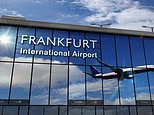
An airport worker has died Germany after contracting malaria from a mosquito believed to have been trapped on a plane, while five other staff members were in hospital.
Frankfurt Airport has placed traps around the building to try to understand the origin and species of the mosquitoes in this rare outbreak.
The Robert Koch Institute – a German federal government agency and research institute for disease control and public health – said an imported Anopheles mosquito carried by an aircraft was the likely cause.
The five other patients are currently receiving medical care for the ‘form of malaria known as airport malaria’, although in July it was reported that there were four infected workers at Germany’s busiest airport.
The Robert Koch Institute said the workers contracted the disease between July 4 and 6.
Airport malaria – also called suitcase malaria or Odyssean malaria – is defined as when an infected mosquito becomes trapped on an airplane or in luggage, which it then transports to a malaria-free area and then bites a person there.
The rarity of the condition means that diagnosis can be delayed, increasing the chance of severe symptoms.
Airport operator Fraport said: ‘A total of six employees have contracted a form of malaria known as airport malaria in connection with their work at the airport.
A Frankfurt airport worker has died in Germany after contracting malaria from a mosquito believed to have been trapped on a plane, while five other staff were in hospital
Traps have been set up around the building to understand the origin and species of the mosquitoes in this rare outbreak (stock photo of a mosquito bite)
‘Unfortunately, we have to confirm that one employee has died as a result of the infection.
‘We have extensively informed all employees and encouraged them to consult a doctor if they have any complaints.’
High fever, sweating, chills and headache, as well as abdominal pain, loss of appetite and muscle aches, are all telltale signs of the disease.
Fraport added: ‘Employees are also advised to inform their doctor that they work at the airport and that cases of airport malaria have been reported at Frankfurt Airport, to ensure they receive appropriate medical examination and treatment.
‘Mosquito traps have also been placed at the airport. Mosquitoes caught in these traps will be genetically analyzed by the Institute of Tropical Medicine in Antwerp, Belgium, to determine their species and origin.”
“We are deeply saddened by the loss of our colleague and our thoughts are with the employee’s family and friends.”
The Robert Koch Institute said cases of airport malaria in Germany are rare – with the last known case at Frankfurt airport from 2023 – and “the lack of travel history may lead to a delayed diagnosis.”
“Delayed diagnosis increases the risk of a severe course of the disease,” it added in its epidemiological bulletin.
Malaria was eradicated from Western Europe in the 1970s and since then almost all cases have involved travelers returning from countries where the disease is still widespread.
But in areas where the infection is common, it is one of the world’s leading causes of death, especially in sub-Saharan Africa.
Treatments exist, and patients caught with the disease early usually make a full recovery.
Frankfurt’s health department continues to monitor the situation and Fraport said they are in regular contact with the responsible authorities.