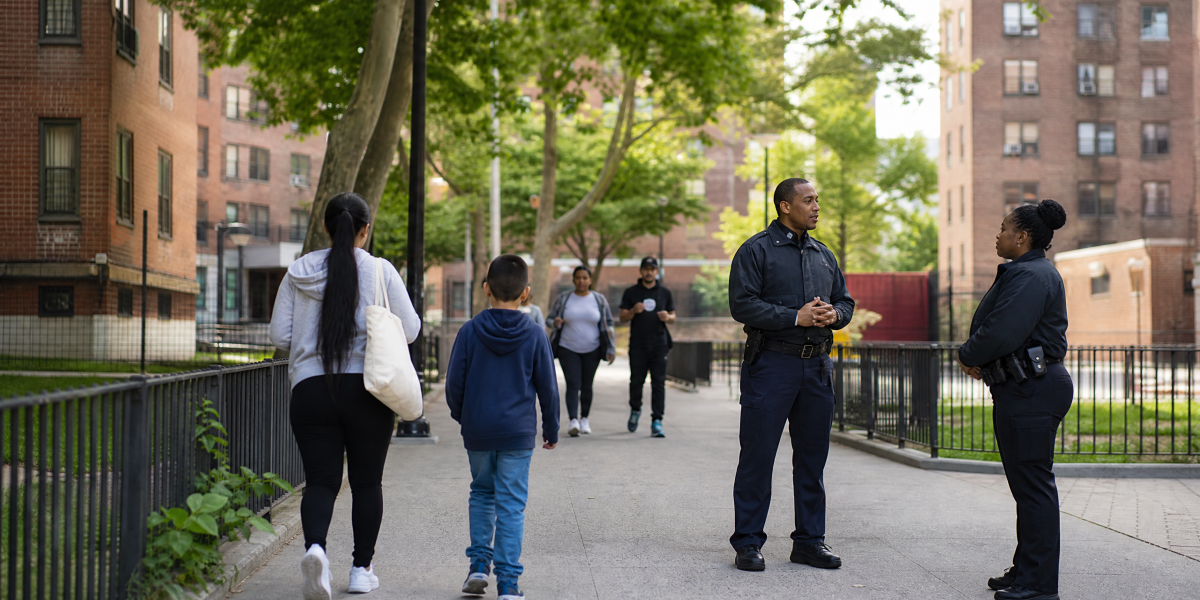
New York officials say public-housing developments in New York City recorded their lowest first-seven-month totals for murders, shooting incidents, shooting victims and robberies in the city’s recorded history. The figures, released Aug. 18 by Gov. Kathy Hochul and NYPD Commissioner Jessica Tisch, cover January through July 2026 and compare the period with the same months a year earlier.
Across city public housing, the state’s release said major crime declined 6.3%, to 3,174 reported incidents from 3,387 during the comparable period in 2025. It reported 11 murders, down from 20; 54 shooting incidents, down from 81; 59 shooting victims, down from 91; and 419 robberies, down from 519.
What the figures cover
The data concern public-housing developments, not every neighborhood or all crime citywide. That distinction is important when interpreting the announcement. The NYPD Housing Bureau is responsible for the safety of nearly half a million residents, employees and visitors across the city’s housing developments, according to the Governor’s Office release.
Officials highlighted a visit to Police Service Area 2 in Brooklyn North, which serves 42 developments in the 73rd, 75th and 77th precincts. The state said shooting incidents in that service area fell 40% and shooting victims declined 45.5% compared with the same period last year.
The announcement describes an official account of the data and the initiatives state and city leaders associate with it. As with any preliminary year-to-date comparison, the numbers reflect a defined period and can change as additional reports are recorded or reviewed. The release does not establish that one program alone caused the changes.
State funding and local operations
Hochul said New York had committed an additional $77 million this year to enhance NYPD resources, on top of $77 million previously invested in fiscal year 2026. The governor’s office described that as more than $150 million invested and committed for NYPD resources since 2025.
The release also points to coordination among resident patrols, community groups, development managers and the Housing Bureau. It says state support enables approximately 5,000 hours of daily Enhanced Transit Safety Overtime and supports mobile field forces and additional resources on trains and platforms. Those broader deployments are part of the state’s public-safety strategy, while the reported public-housing figures refer specifically to the first seven months of the year.
Why a careful reading matters
Year-to-date crime statistics are useful for describing recent conditions, but they should be read with their geography and time frame in mind. A decline in several high-harm categories can be meaningful for residents and frontline workers, yet it does not erase safety concerns or speak for every development equally. The announcement itself focuses on aggregate results and investment commitments rather than individual incidents.
The next months of data will show whether the early-year pattern holds. Residents can also look to local precinct, Housing Bureau and city public-safety information for updates relevant to a particular development or neighborhood.
What residents can take from the announcement
The data provide a citywide public-housing snapshot for a limited period, while people’s experience of safety can vary from one development and block to another. The useful questions are both numerical and practical: how are incidents classified, what time period is being compared, and what local resources are available when residents need help? Those questions apply alongside any year-to-date reduction.
The state’s release attributes part of the reported pattern to partnership and resource investments, but it does not claim that funding alone explains every change. Continued reporting, transparent data and communication with residents are important as the city moves through the rest of the year.
The reported figures are incident counts and comparisons, rather than a measurement of every resident’s experience. The “record-low” description in the announcement applies to the listed categories through the first seven months of the year. It should not be generalized to every category of crime, every housing development or every part of the city without examining the relevant data.
For continuing New York and public-interest coverage, follow NY Breaking News. The official New York State release contains the full January-to-July comparison and funding context.