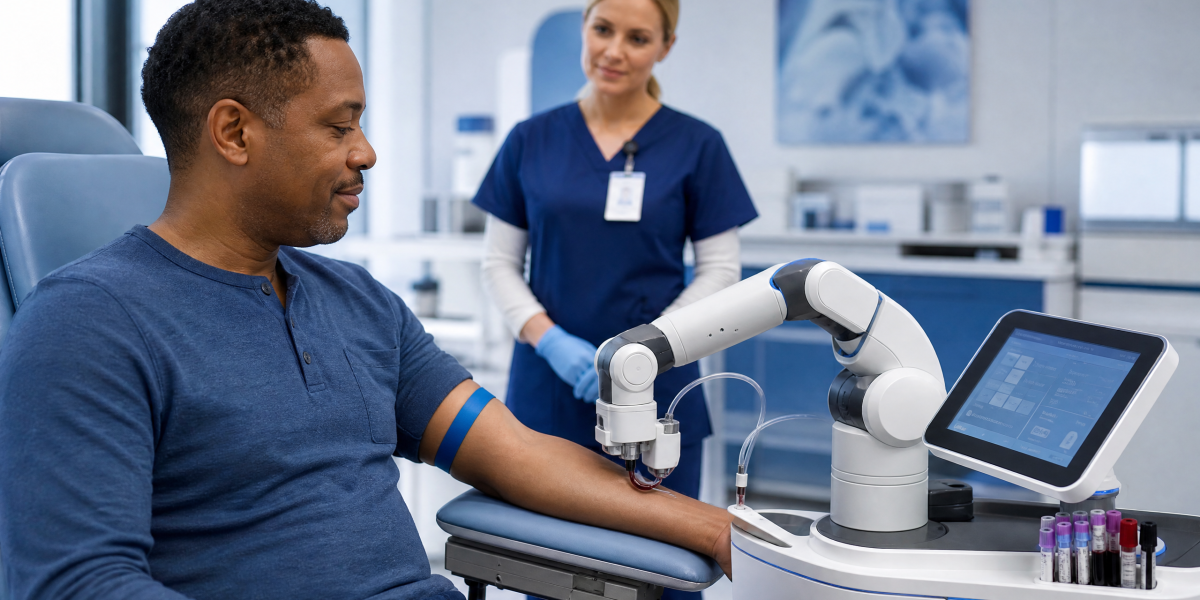
The Food and Drug Administration has authorized Aletta, a standalone robotic device designed to draw blood from an adult patient’s arm in outpatient settings. The authorization does not remove trained staff from the process: the FDA says a supervisor trained in phlebotomy must oversee use of the device, and one trained phlebotomist may supervise as many as three units at one time.
The Aug. 19 decision is notable because blood collection is among the most routine procedures in health care, while clinics and laboratories continue to face staffing pressure. The FDA described Aletta as the first standalone device authorized to perform a blood draw without hands-on operator intervention after a trained person starts the session. Its authorization applies to adults in outpatient care, not to every setting or every patient.
How the authorized system is designed to work
According to the FDA announcement, the device guides a patient to position an arm, then begins only after the patient or supervising worker presses a button. It uses near-infrared light and Doppler ultrasound to look for a suitable vein and distinguish veins from arteries. If it cannot identify an appropriate vein, the FDA says it will not attempt the draw.
Once a suitable vein is found, the system can apply a tourniquet, prepare the skin, insert and dispose of a needle, change collection tubes and place a bandage. The supervising phlebotomist remains responsible for confirming that tubes are filled in the right order and have enough specimen after collection. That supervision requirement is an important limit on what “standalone” means in this authorization.
The FDA said the device includes safety features intended to stop the procedure if a patient moves too much. It also described sensors that can pause the process and alert the supervisor if the system detects unsafe conditions. A trained professional is expected to clean the device between patients.
What the FDA reviewed
The authorization was granted to Vitestro through the De Novo pathway, which the agency uses for certain new low- to moderate-risk device types. The FDA said the clinical data it reviewed showed successful blood-draw rates comparable to or better than trained human phlebotomists when the device proceeded with a stick. The study population included people with varying health conditions, self-reported difficult vein access and different skin tones, according to the agency.
The FDA also said device-related adverse events in the reviewed data were uncommon and mild. That finding should not be read as a guarantee that every draw will succeed or that the device is suitable for every individual. The authorization establishes special controls covering matters such as labeling, performance testing and clinical testing. Those controls, together with general device requirements, are meant to provide what the agency calls a reasonable assurance of safety and effectiveness.
Why the decision matters for outpatient care
For patients, the near-term question is likely to be where and when clinics choose to adopt the system. The FDA authorization is a regulatory milestone, not a nationwide rollout announcement. Individual outpatient facilities will still decide whether the technology fits their staffing, workflow, training and patient-care needs.
For health systems, the potential attraction is operational: a trained phlebotomist could oversee multiple devices while remaining available to intervene. The agency specifically connected the authorization to a growing shortage of phlebotomists. The decision also illustrates how regulators are assessing automation in clinical settings by looking at both the technology’s performance and the human oversight that remains in place.
Authorization is not a universal clinical recommendation
The agency’s action allows the device to be marketed within its authorized indication; it does not tell every clinic to adopt it or establish that it is the best option for every patient. Patients who have questions about a planned blood draw can ask their care team how collection will be performed, who will supervise the procedure and what alternatives are available in that setting. The FDA’s description of the system also makes clear that a trained phlebotomy supervisor remains part of the workflow.
Automation in health care is often discussed as a substitute for staff, but this authorization is more limited. The approved model combines an automated collection process with human initiation, supervision and verification. That division of responsibilities is central to the decision and may shape how outpatient organizations evaluate the technology.
Readers can follow other Health coverage from NY Breaking News. For the regulatory record and the FDA’s description of the device’s authorized use, safety features and review pathway, see the agency’s original announcement.