I get on the back of a Vespa, driven by a young, handsome Italian, and arrive late, nervous and full of apologies for my pasta course.
It’s not exactly the first impression I’d hoped for from my teacher – especially since she’s a real Italian nonna. But I didn’t have to worry.
Despite not speaking a word of English, Nonna Rosella beams when she sees me, pulls me into a warm hug and plants a kiss on each cheek.
Within moments I have a glass of cold white wine in one hand and a slice of bruschetta in the other, generously topped with fresh, juicy tomatoes and drizzled with beautiful Italian olive oil.
Any shame about my late entrance disappears immediately.
Now that all four of my grandparents and my two step-grandparents are no longer with us, there is something unexpectedly poignant about being welcomed so enthusiastically by an older woman.
For the next few hours, Rosella becomes our temporary grandmother, feeding us, teasing us and intervening when our pasta dough threatens to go disastrously wrong. And mine often does that too.
This is “granny tourism,” a growing travel trend that encourages visitors to trade impersonal tours for experiences led by older locals.
Hayley heads to Rome to try out ‘granny tourism’, the latest travel trend that swaps crowded tourist traps for authentic experiences with locals
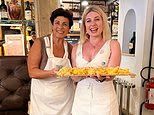
Together with six other aspiring chefs, Hayley quickly gets to grips with making pasta under the expert eye of Rosella
Rather than simply snap a photo outside a famous landmark and move on, travelers learn family recipes, hear firsthand stories, and see destinations through the eyes of the people who spent their lives there.
Rosella is one of the ten nonnas regularly organizes pasta making classes in Rome, which can be booked via GetYourGuide.
Together with an English-speaking interpreter, she takes me and six other aspiring chefs – including a child – through two classic Italian dishes: ravioli stuffed with ricotta and spinach, followed by tagliatelle.
As someone who would never describe herself as a natural in the kitchen, I’m initially skeptical that anything I make will be edible. However, Rosella seems to have complete confidence in me.
She shows us that fresh pasta only requires flour, egg, a rolling pin and lots of fat – although, if her method is anything to go by, a big smile and a generous helping of love are equally essential ingredients.
First we pour flour on our work surface, make a well in the center and break an egg into it. Then comes the messy task of gradually working everything together until it starts to resemble dough.
Rosella makes every stage look effortless. Her hands move instinctively, aided by years of experience, while the rest of us repeatedly look around the room to check if our mixtures are anything like hers. Not mine.
Rosella shows Hayley and her classmates how to make two simple Italian pasta dishes: ravioli filled with ricotta and spinach and tagliatelle
She sees me struggling and comes over to rescue my dough, kneading and turning it before handing it back with an encouraging smile.
There is no shared language between us, but there is no real need for one. A pointed finger, an exaggerated expression or a loving pat on the arm tell me exactly if I’m doing it right.
Once our dough has rested, Rosella calls us forward one by one to feed it through the pasta machine.
It’s supposedly a lesson, but in her hands it feels more like a performance.
She laughs and jokes with each member of the group through the translator, patiently correcting our technique and gently mocking our less successful attempts.
She is particularly playful with the two men in our class and greets them with a mischievous glint in her eye.
After rolling the dough repeatedly until it is thin and silky, we divide it in half.
Hayley explains how half of her dough is covered with mounds of ricotta and spinach filling, topped with another sheet of pasta and then cut into five small ravioli parcels.
One half is covered with mounds of ricotta and spinach filling, covered with another sheet of pasta and cut into five ravioli parcels.
Rosella then teaches us a wonderfully simple trick to make tagliatelle. We cut the remaining dough into thin ribbons, slide a knife under it and lift it up so that the strands fall down before shaking them loose.
It’s the kind of technique that looks incredibly impressive, but is easy enough to recreate at home – even for me.
Once the cooking is done, Rosella gathers us for photos, throws her arms around us and subjects me to a surprise attack of tickling.
Then we sit together around a long table to eat our handiwork like one big, somewhat chaotic family.
The ravioli arrives first, coated in a simple brown butter sauce that allows the creamy filling and fresh pasta to shine. The tagliatelle follows, and both taste much better than I expected when I first stared at my unpromising pile of flour and egg.
After their lesson with Rosella, Hayley and her classmates sit down together to sample their craft. First up: ravioli in a simple brown butter sauce
There’s also something especially satisfying about eating food you made from scratch under the watchful eye of an Italian grandmother.
Rosella observes as we take our first bite and looks delighted at our reactions. For her, it doesn’t just seem to be about the class teaching tourists how to make pasta. It’s about passing on a tradition and bringing people together through food.
Experiences like these are becoming an increasingly important part of the way people travel.
Social media is flooded with videos of tourists learning family recipes from Italian nonnas, being guided around the city by locals and hearing stories that would never appear in a conventional guidebook.
According to GetYourGuide, searches for these types of activities have increased by 38 percent, while bookings for workshops and classes have increased by more than 250 percent globally between 2023 and 2025 – significantly outperforming traditional attraction tickets.
The appeal is authenticity: the chance to feel, however briefly, that you are participating in local life rather than just observing it.
That can be especially difficult in Rome, one of the most visited cities in the world, where lines stretch for miles outside the Colosseum and people jostle for the perfect photo at the Trevi Fountain.
Yet my afternoon with Rosella feels warm and personal.
Earlier that day I had experienced something similar during the Vespa tour that was responsible for my late arrival.
In addition to her pasta-making course, Hayley explores some of Rome’s lesser-known corners on a Vespa tour
I had only visited Rome a year earlier, but riding through on the back of a scooter showed me a completely different side of the city.
On my first trip I focused on the big names: the Colosseum, the Trevi Fountain, the Spanish Steps and the Vatican Museums.
This time I weave through the busy streets of Rome behind a local driver, away from the main crowds and climb into the hills above the city.
On Janiculum Hill we see the cannon being fired – an extremely loud tradition that takes place every day around noon and dates back to the 19th century, when the explosion was used to tell the exact time to the churches of Rome.
We are also taken to the Fontana dell’Acqua Paola, a huge marble fountain that overlooks the city. It’s just as dramatic as the Trevi Fountain, but considerably less crowded.
From there, Rome spreads out below us, with its domes and terracotta roofs glowing in the sun.
On the recommendation of her Vespa guide, Hayley is also taken to the Fontana dell’Acqua Paola – as dramatic as Rome’s Trevi Fountain, but without the crowds
Our drivers also give us the kind of recommendations that are difficult to find through a general online search.
They suggest spending the evening in Piazza Trilussa, which comes alive at night with music and street performances, before continuing to Sharivari, a nightclub hidden near the Pantheon.
We follow their advice and end up dancing until the early hours – enjoying the kind of lively Roman night that I’m sure my naughty new nonna would approve of.
Of course, there’s nothing wrong with visiting Rome’s most famous sights. The Colosseum is spectacular, the Vatican Museums are extraordinary and I would never suggest leaving the city without tossing a coin into the Trevi Fountain.
But it’s the people I remember most vividly from this visit: the locals who drove me through the streets on his Vespa, the recommendations I shared along the way and, above all, Nonna Rosella who laughed as she tried to save my pasta.
I leave Rome feeling like I have been welcomed into a very dysfunctional Italian family.