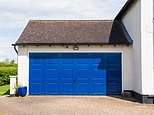
My neighbor recently had builders visiting to see if their detached garage could become a music studio.
They regularly give music lessons, the man plays the drums and the woman sings. I’m worried about the noise.
They say they don’t need a building permit, is that true? BEN
Noise problem: This reader is concerned that his neighbor’s new music studio will disturb him
Sophie Warburton from This is Money replied: A garage conversion rarely requires planning permission, but your neighbors can contact their local authority to be sure.
If the work is carried out on the inside and the size of the building is not affected, it usually falls under what is known as permitted development.
This is essentially an exemption from the need to apply for a building permit, which covers several common types of construction work.
However, there are other important factors your neighbors should consider when turning a garage into a habitable space – and if the noise bothers you, there are things you can do about it.
I contacted two experts to ask for their advice.
Alex Peters, expert at Checkatrade says: In most cases, your neighbor is right: you don’t need planning permission to convert a garage into a space such as a music studio, as long as the work stays within permitted development limits.
What is not optional here, however, is the approval of building regulations.
Expert Alex Peters says the neighbors must have a building permit signed.
Turning any garage into a habitable space – whatever it is used for – requires building regulations approval, which covers issues such as insulation, fire safety, electricity and ventilation.
You can request this through your municipality or a private approver. You may have to pay a fee for this.
When it comes to noise, it may help if the garage is soundproofed as part of the renovation, but persistent noise from drumming, singing or teaching falls under general nuisance legislation.
If it becomes a persistent problem, the council’s environmental health team can advise whether it qualifies as a legal nuisance, separate from any planning issues.
A friendly chat directly with your neighbor about times of day and soundproofing can be the quickest solution before the situation escalates.
Ian C. Walmsley, founder of planning consultant Planning Geek, says: Turning a garage into a music studio and using it to teach paying students are two slightly different planning questions.
Simply converting a garage does not automatically require a building permit. If the work is mainly internal and the garage remains part of the home, a building permit will often not be required.
Its use as a private music room does not require a building permit in itself. There is nothing in urban planning law that says you need permission just because you play the drums, sing or practice another instrument at home.
The function becomes more interesting if the garage is also used for regular music lessons.
Ian C. Walmsley says the house’s status as a potential commercial property should be taken into account
You are allowed to work from home without automatically needing a building permit. Even getting paid and having customers visit does not in itself mean that there has been a change of use.
The key question is whether the company has become important enough to change the character of the building from an ordinary home.
Councils will look at issues such as how many pupils arrive, how regularly lessons take place, the hours involved, extra cars and parking, and – particularly relevant here – the amount of noise and disruption to neighbours.
Piano lessons after school a few times a week are therefore very different from a succession of students coming in all day while drums and amplified music can be heard regularly next door.
There is no magic number of classes that suddenly require a building permit. It’s what planners call a matter of “fact and degree.”
The homeowners should also check the construction history of the home. Particularly on newer residential developments, an original building permit may contain a condition requiring that a garage remain available for parking, or that certain permitted development rights be revoked.
When such a situation arises, the normal assumption that a garage can simply be converted may be incorrect.
Listed buildings require special care and other restrictions may apply.
Does it matter if the garage is detached?
Ian C. Walmsley says: Potential. An attached garage is normally part of the home itself. Internal conversion work often does not require planning permission, whilst external changes may fall within the normal permitted building rights for altering a house.
A detached garage is an outbuilding. Permitted development rights for the construction or conversion of detached outbuildings vary and are for purposes related to the enjoyment of the home – things such as residential garages, workshops, gyms and hobby rooms.
A private recording or music room could easily fall into that territory. A building specifically designed to house a substantial music education business is more difficult.
This does not mean that permission is automatically required to place a desk, drum set or piano in a detached garage. The municipality still has to take into account the reality of what is happening in the building.
What about the noise?
Ian C. Walmsley says: This is perhaps the most important point for the concerned neighbor.
If drumming, amplified music or repeated lessons cause an unreasonable and substantial disruption to the neighbours’ enjoyment of their homes, the council’s environmental health team may investigate this as a possible statutory nuisance.
This remains possible, even if the music studio itself is completely legal from a planning perspective.
If the problem ultimately turns out to be the volume of the drums and not the use of the garage, environmental health may prove considerably more helpful than the planning department.
The simplest rule of thumb is this: pursuing a hobby or working from home normally does not require a building permit. Turn your home into a place that noticeably behaves like a business premises.
SAVE MONEY, EARN MONEY
Up to €250 cashback
Up to €250 cashback
2.5% cashback with an investment of at least € 200
4.61% cash Jes
4.61% cash Jes
Trading 212: 1.01% fixed bonus of 12 months
€3,000 cashback
€3,000 cashback
£100-£3,000 cashback when opening Sipp
Up to €150 cashback
Up to €150 cashback
Open a savings account with at least €5,000
Welcome bonus
Welcome bonus
Receive up to €200 when you invest €100
Affiliate links: If you purchase a product, This is Money may earn a commission. These deals have been chosen by our editors because we believe they are worth highlighting. This does not affect our editorial independence. General terms and conditions apply to all offers.