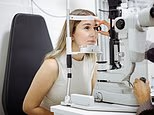
One day, opticians on the high street could be used to make diagnoses depressionsuggests one study.
Scientists have found that specialist images of the back of the eye, often taken as part of standard eye tests, can hold clues about who is at risk of depression years later.
Their research, based on a survey of 40,000 British adults, found that people with wider veins leading to the retina – a layer of light-sensitive tissue at the back of the eye – were up to 50 percent more likely to develop depression over the next ten years.
One theory is that depression can cause chronic inflammation throughout the body, causing the retinal veins to dilate as a result.
Ophthalmologists from the International Eye Center at Shantou University in China analyzed eye image data from healthy men and women, who were then followed for an average of 11.3 years.
High street opticians could one day be used to diagnose depression, study finds
During that time, 1,402 of them were diagnosed with depression – and scientists found that having wider retinal veins was associated with a 25 percent increased risk of the condition.
They added that, in the absence of an objective test for depression, retinal images could be a “promising, accessible candidate” to help make the diagnosis.
The researchers wrote in the Journal of Affective Disorders: “Our study… provides strong evidence that vein dilation precedes the onset of clinical depression.”
However, they added that more research was needed before retinal images could be used to diagnose the condition.