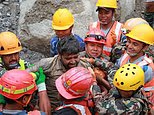
Two hydropower workers were pulled alive from a rubble-buried tunnel in Nepal on Friday, a rare glimmer of hope in the 10th day of rescue efforts after the catastrophic Himalayan floods.
Rescuers cheered as a man emerged through a muddy opening, a Department of Energy video showed.
He was helped to his feet by rescuers and later carried on the backs of emergency workers as they took him to a helicopter.
A photo showed the second man caked in mud, his hands pressed together in prayer, as rescuers took him away on a stretcher.
Rescue workers called it a “miracle” after last Wednesday’s disaster, which left at least 1,200 people dead and more than 5,000 missing. China and Nepal.
“I am so happy, my heart is lighter,” said Amir Maharjan, brother of 45-year-old rescued worker Kabir Maharjan.
The men were identified by Home Minister Sudan Gurung as Sanjay Shah, 30, a mechanical foreman, and Maharjan, a mechanical supervisor.
The Nepalese army said the two men were receiving medical treatment and that “search and rescue operations are underway.”
The two are among hundreds of hydropower workers missing since a wall of mud and rubble swept through the region on August 26 following a massive glacier and rock collapse on a mountain on the China-Nepal border.
Dramatic video obtained by CNN showed a dozen rescuers pulling a man from a small hole in the ground
Rescue crews are seen carrying one of the rescued power plant workers to safety
The rescue came during a desperate operation to drill into the tunnel to search for 42 workers still missing after the deadly August 26 floods.
Energy Minister Biraj Bhakta Shrestha confirmed that rescue operation at the Trishuli 3A tunnel.
Searches continued in that tunnel and other locations, with at least twelve hydropower projects destroyed by the floods.
The government had initially said it believed more than 100 workers could be living in multiple tunnels.
Nepalese rescuers, assisted by experts from India, China and South Korea, have continued to search for survivors believed to be trapped in hydropower tunnels, but teams repeatedly hit walls of packed rubble.
Until Friday, none of the tunnel workers had been confirmed alive.
Australian rescue expert Arnold Dix, who supported the operation remotely, said the rescue efforts were “back in wonderland” after a “week of 24/7 heartache”.
Earlier Friday, Dix said teams at the Trishuli 3A hydropower project believed they had heard a faint response from the tunnel.
“They think they have received a weak response from within saying ‘hunchha’, yes or okay,” said Dix, president of the International Tunneling and Underground Space Association, adding that he was heading to Nepal to join the rescue effort.
He said rescuers shouted into the tunnel: “Don’t worry, we are rescuing you.”
Dix was a key advisor during the Himalayan rescue effort that successfully freed all 41 Indian workers trapped in a collapsed road tunnel under construction in 2023.
Dix said teams had dug through the rubble blocking the tunnel for 50 to 60 meters and had hoped for a breakthrough at any moment.
Less than an hour later, rescuers brought the two men to safety.
The photo shows soldiers leading a power plant worker to safety on Friday morning
A Nepal Army soldier is seen trying to sift through the mud during the search efforts
Nepali Army soldiers work during a search and rescue operation outside a tunnel near the Hydropower Project sites on Wednesday
Some Nepalese families searching for their missing loved ones had begun organizing symbolic funerals in recent days, in a sign of dwindling hope for survivors.
Foreign Minister Shisir Khanal has called the gigantic wave caused by an avalanche of rocks and ice a ‘Himalayan tsunami’.
Floods had swept through mountain areas that day, destroying roads, bridges and several hydropower dams.
Entire sections of settlements were wiped out, leaving the landscape like a puzzle with pieces missing.
Picturesque villages with green rice fields and houses lay next to large areas of washed away land.
Communities near the epicenter remain cut off.
The United Nations has warned that the “scale of destruction” makes delivering aid a huge challenge, with cargo drones and carriers believed to be able to reach isolated communities.
“Access has been very, very, very difficult,” said UN chief in Nepal Lila Pieters Yahia.
Nepal’s disaster authority says the number of bodies recovered is 1,259, while 5,083 people are missing.
In China, state media say 21 people have been killed and 541 people are missing. That brings the total toll to 1,280 people, of which 5,624 are missing.
The missing include more than 800 foreigners from at least 34 countries, including tourists and pilgrims, in both Nepal and Tibet in China.