HONORS recipients believed to have posted “offensive” comments online could be stripped of their awards, according to official guidelines.
The forfeiture committee, which meets in secret and reviews complaints against tribute holders, can now consider “hate incidents” as grounds for action.
These can be places where ‘the victim or someone else’ thinks [the incident] was motivated by hostility or prejudice based on one of five prescribed characteristics: disability, race, religion, transgender identity or sexual orientation’.
It raises the specter of people being stripped of honors from MBEs to knighthoods because of comments deemed offensive – even if their comment doesn’t break any law.
Lord Young of Acton, founder and general secretary of the Free Speech Union, warned that the move could make potential recipients ‘think twice’ about accepting an honor in the future.
Details of the guidance emerged as a report by campaign group Big brother Watch found that more than 60,000 people have been arrested for “communications offences” – many of which were social media posts – in the past five years.
Lord Young said: ‘[If] people know that their award can be revoked if they say something politically controversial that the committee disagrees with, even if it is a perfectly legal, mainstream view, anyone right of center will think twice about accepting one in the future.
The guidelines for the forfeiture committee, reported by The Sunday Telegraph, state: ‘The overriding consideration for the committee should be the question: ‘Have the individual’s actions or inactions brought the awards system into disrepute?’
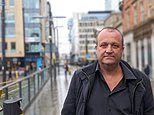
Homelessness campaigner Nick Buckley MBE revealed the existence of the directive following a Freedom of Information request
It adds: ‘A message on Twitter [now X] by a high-profile recipient, under an open account with hundreds of thousands of followers, would likely be viewed as more serious than the same message tweeted by a person with a locked account not publicly accessible, and a small following.”
The guidelines could apply to ‘hate incidents’, which ‘cannot be prosecuted’ – where comments ‘do not amount to criminal conduct’.
The Free Speech Union (FSU) called the criteria for withdrawing awards ‘far too broad’.
Details of the new guidelines were revealed by homelessness campaigner Nick Buckley, who was awarded an MBE in recognition of years of charity work.
The committee investigated Mr Buckley and considered removing his MBE over comments on social media which it deemed ‘beyond political commentary’ and which it said had ‘brought the honors system into disrepute’.
Among the controversies involving Mr Buckley – who stood as an independent against Andy Burnham in the 2021 Great Manchester mayoral election – were reports on X about boxer Anthony Joshua last year.
In 2020, Buckley was removed and then reinstated by the board of Mancunian Way, the homelessness charity he founded, after calling the Black Lives Matter movement “neo-Marxist”.
Lucy Connolly, whose offensive social media post led to her jailing, is among 60,000 people arrested for ‘communications offences’ in the past five years
Mr Buckley, who was allowed to keep his award, learned of the guidelines after filing a Freedom of Information request.
In a letter making the guidelines public, Mr Buckley wrote: ‘Without a transparent policy, all honor officers will be in a position where they feel unable to express their beliefs without compromising their honour.’
The government declined to comment.
In addition, a report from Big Brother Watch – published this week – reveals the scale of arrests for ‘communications offences’, some of which are as trivial as watching disparaging TikTok videos.
It reveals that at least 62,199 people have been arrested in Britain over the past half-decade, with 18,510 charged and 12,292 convicted.
Campaigners say that while some of the arrests will be justified – such as interventions to stop threatening messages from violent partners in domestic violence cases – the scope of the laws has led to a wave of overzealous policing.
The report cites the case where West Midlands Police attended the home of a vulnerable teenage girl to charge her over a TikTok post containing an image of a teacher making negative comments.
They demanded that the girl hand over all her devices and either attend a voluntary interview or be arrested – even though she had not created, shared or commented on the video.
In another high-profile case, Lucy Connolly was sentenced to 31 months in prison after calling for the burning of hotels housing asylum seekers following the Southport murders in July 2024.
Toby Young, chief executive of the Free Speech Union, told The Mail on Sunday: ‘The sheer number of people arrested for online offences, even if only one in five are ultimately convicted, cannot help but have a chilling effect on freedom of expression.’
Silkie Carlo, director of Big Brother Watch, said: ‘Andy Burnham must order an independent review of our laws and police training around speech to fix this Orwellian mess.’