Scientists may have gotten their first glimpse of dark matter – the mysterious substance thought to hold the universe together.
Researchers have discovered one unusual particle interaction deep underground that they have struggled to explain.
They discovered what appears to be a collision between an ordinary atom and a particle unknown to science.
If true, it could help solve one of science’s greatest mysteries: revealing what much of the universe is made of.
The idea of dark matter has been suggested for almost a century, but despite decades of searching, scientists have never directly discovered it.
It is believed to make up about 85 percent of all matter in the universe, but it does not appear to absorb, reflect or emit light, making it effectively invisible.
Now an international team of 250 scientists and engineers from 39 institutions in six countries has discovered something that could provide a clue.
The researchers spent two years scrutinizing data from the LUX-ZEPLIN (LZ) experiment, one of the world’s most sensitive dark matter detectors.
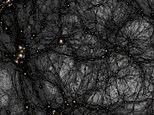
Scientists may have caught their first glimpse of dark matter – the mysterious substance thought to hold the universe together (artist’s impression)
Hidden beneath about a mile of rock in South Dakota, the massive detector contains 10 tons of ultra-pure liquid xenon.
The idea is to capture the incredibly faint flashes of light produced when a dark matter particle collides with a xenon atom.
The rock above helps protect the experiment from cosmic rays, while additional detectors and advanced computer systems help remove signals produced by ordinary matter.
But when the researchers examined the data, they found one particle interaction that stood out from the expected background.
It could possibly have been produced by a weakly interacting massive particle (WIMP) – one of the leading candidates for dark matter.
Dr. Sam Eriksen, from the University of Bristol and lead author of the analysis, said: ‘Scientists have been trying to better understand dark matter, which makes up the vast majority of matter in the universe, for almost a century.
‘What we observed in this analysis could be the first step in understanding dark matter as a particle.
“After a tremendous amount of scientific effort, this is incredibly exciting.”
The researchers spent two years examining data from the LUX-ZEPLIN (LZ) experiment, one of the world’s most sensitive dark matter detectors.
However, the researchers cautioned that this is just one event – with not nearly enough evidence to declare that they have discovered dark matter.
The result has a statistical significance of 2.6 sigma – which corresponds to a roughly 0.5 percent probability that an event is at least that unusual given expected background processes.
Physicists generally require five sigma significance before announcing a discovery.
Professor Rick Gaitskell from Brown University said: ‘We are very intrigued to see this event in the data, in the region where we expect dark matter to appear and the competing backgrounds are very low.
‘We don’t want to get ahead of ourselves with just one event. We’re not claiming to have seen dark matter.
“But we saw something interesting that we want to share with the scientific community for their input.”
The researchers say they have thoroughly investigated possible explanations involving ordinary matter, but have not yet found a clear cause for the unusual event.
Dr. Eriksen presented the findings at the 2026 TeV Particle Astrophysics conference in Japan.
The results have now been made available for research by other scientists and submitted to a scientific journal for publication.