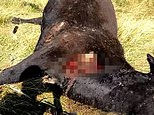
Livestock are found dead in remote areas Oregon having their blood apparently drained and their udders, tongues or genitals removed via clean, scalpel-like cuts.
There are no signs of a struggle, no marks around the carcasses and none of the torn flesh or teeth marks normally left by predators.
It is estimated that more than 10,000 livestock mutilations have been reported in the US over the past half century, spawning theories about cults, secret government experiments, UFOs and mythical creatures like the chupacabra.
Now a new documentary, Not One Drop of Blood, available to stream this week on Amazon Prime Video, examines the ongoing phenomenon and a recent cluster of cases in remote Oregon’s Harney County.
The mystery deepened in February 2021, when a mutilated cow was discovered on ranch land, before six more were found across the province with missing body parts and reportedly no blood.
A local law enforcement officer admits in the film that the stunning evidence drove even him to make an extraordinary statement: “My personal opinion, they’re aliens.”
Authorities found nothing indicative of predators, rustlers or poisonous plants, while local veterinarians said the wounds looked more like scalpel cuts than animal bites.
Yet filmmakers Jackson Devereux and Lachlan Hinton say the lack of answers has exposed a deeper crisis facing overburdened authorities and a farming community already fighting to preserve its way of life.
Cattle are found dead in remote areas of Oregon, with blood apparently drained and udders, tongues or genitals removed through clean, scalpel-like cuts
According to Devereux, Harney County is the ninth largest county in the U.S. by area, and its livestock outnumber its residents fourteen to one.
It can take hours for officers to reach the immense, isolated farms, leaving investigators little hope of preserving evidence when another carcass is reported.
Devereux, an Australian filmmaker based in New York, heard about the mutilations from friends in a traveling rock band who overheard a radio report in Oregon about six dead cattle.
He and Hinton contacted journalist Anna King, who had reported on the cases and joined the documentary as a producer. They interviewed police, ranchers, farm workers, young residents and indigenous people.
“It just felt very cinematic and bigger than just the simple viral element of the mystery,” Devereux said. ‘It is these vast landscapes that carry with them a kind of mystery.’
The documentary focuses on descriptions that are repeated in countless cases: animals appear to have simply collapsed, leaving no dirt or hoof marks to indicate a violent struggle. Their tongues, udders and reproductive organs are missing, yet there is none of the devastating damage expected from scavengers.
Rancher Clint Weaver initially believed a dead bull had been killed while fighting another animal.
“At first we thought it was just about the bullfights, so we kind of based that on a death,” Weaver said.
‘And then we found another one. And then we started to look at them a lot closer, and noticed that their testicles and their reproductive organs were gone. Then we drove up the creek and found the rest.”
“And it was the same: the testicles, the reproductive organs, sometimes the tongues were gone. And then we knew something was going on, so we called the police.”
It is estimated that more than 10,000 livestock mutilations have been reported in the US over the past half century, spawning theories about cults, secret government experiments, UFOs and mythical creatures like the chupacabra.
Now a new documentary, Not One Drop of Blood, available to stream this week on Amazon Prime Video, examines the ongoing phenomenon and a recent cluster of cases in remote Oregon’s Harney County.
The apparent absence of blood in the animals is one of the most baffling details and inspired the title of the documentary.
Investigators found no traces or evidence that the cattle had eaten a deadly plant, Devereux said. Local veterinarians also dismissed predator attacks as an explanation, saying an animal biting and tearing at flesh would visibly leave behind other damage.
“This looks like a scalpel,” Devereux said of the wounds. “It’s very precise.”
He initially suspected that natural causes or insects could explain the deaths. But farmers monitor their livestock daily and generally recognize signs that an animal is sick, he said, growing increasingly unsure as each possible explanation comes up against another contradictory detail.
A local law enforcement officer admits in the film that the stunning evidence pushed even him to make an extraordinary statement: ‘My personal opinion, they’re aliens’
The film explores a wave of mutilations in Harney, Oregon
Similar mutilations have been reported in the US, Canada and Mexico since the late 1960s. Elk and deer have also reportedly been found with similar injuries.
The phenomenon has led to what Devereux described as a cult-like following within the paranormal community. Linda Moulton Howe’s 1980 documentary Strange Harvest famously investigated claims that aliens were responsible.
Many Harney County residents nonetheless suspect human attackers. Their theories include people using poison darts to incapacitate livestock before their blood is drained and organs are removed for ritual or illegal purposes, although researchers have found no evidence to support these ideas.
Devereux believes UFO and paranormal theories persist because residents and researchers have been confronted with the same disturbing details for about 50 years without finding a conventional answer.
Harney County Sheriff’s Department Officer Matt Ellibee said he and the sheriff had considered statements involving devil worshipers and the occult. But the seemingly impossible circumstances made him think about something even more extraordinary.
“My personal opinion is that they are aliens,” Ellibee said. ‘I don’t know how else to explain it.
‘Do I believe in aliens? Don’t know. I don’t believe we are the only intelligent species in our universe. But unless there’s a super secret Black Op group that can do this kind of thing, I don’t know what else it could be.”
He wondered whether an unknown clandestine operation might possess the ability to kill and mutilate the animals without leaving evidence, adding: “Unless there’s a super-secret squirrel black-op group that can do this kind of thing, I don’t know what else it would be.”
Authorities found nothing indicative of predators, rustlers or poisonous plants, while local veterinarians said the wounds looked more like scalpel cuts than animal bites.
The filmmakers found sheriff’s office reports of livestock mutilations from the 1970s. Devereux said their descriptions were “virtually word for word” the same as the reports written more than fifty years later.
Part of the problem is practical. Officers may travel two hours to investigate a new case, only to find no traces, physical evidence or a clear cause of death. They must then turn their attention to more immediate crimes, with the investigation into the cattle remaining unsolved until another animal is found.
Efforts to coordinate investigations between different provinces and agencies have also failed to produce a conclusive explanation.
The documentary connects the mystery with a farming culture that, according to Devereux, is at a crossroads. Families work around the clock on vast properties, wondering whether younger generations, now connected to life outside the province via the Internet, will continue to operate the farms.
The directors approached the project skeptically, but Devereux admitted that the landscape could make even unlikely explanations possible.
“You stop and look around, and you see nothing but cow eyes and pitch blackness in the sky,” he said. ‘At that moment you have the feeling that anything can happen in these landscapes.’