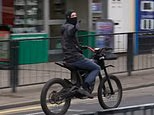
New powers to tackle young people wearing balaclavas to intimidate the public Nottingham city center will come into effect next week.
Nottinghamshire Police said the restrictions, which start on Tuesday, will allow police and council officers to require people to remove their face coverings if their identity is concealed. crime or behave antisocially.
The powers, part of a public places protection order, include on-the-spot fines of £70, confiscation of the face covering and referral to an immediate justice program requiring community work.
The bans are part of a wider plan to make Nottingham safer, after a recent report called it the ‘seventh most unsafe place in the country’.
Evidence collected by Nottinghamshire Police identified more than 180 incidents involving face coverings or balaclavas in the city center between June 2025 and June 2026.
In July 2024, two balaclava-wearing teenagers, aged 13 and 19, murdered a 24-year-old man with a brick after he made “rude sexual comments” to two 14-year-old girls.
The 13-year-old boy, who cannot be named for legal reasons, and Kai Howitt, 19, were jailed for four and a half years and 14 years respectively for the murder of Jack Edwards at the Sussex Street skate park in Nottingham.
Those who continue to defy the order could be issued with a Criminal Behavior Order, which could ban them from the city center indefinitely.
It has been stressed that the crackdown is not a blanket ban on face coverings, with officers targeting ‘crime, anti-social behavior or intimidating behaviour’, and that there are clear exceptions to protect people wearing face coverings for legitimate reasons such as religious, health, medical or work needs.
Nottingham city commander, Chief Inspector Chris Pearson, said: ‘Any person wearing a balaclava or similar face covering in the city center who we suspect is involved in crime or anti-social behavior will be stopped by our officers.
‘We will then use all available forces to ensure that they can no longer wear that item of clothing.
‘This is all about disrupting crime. I couldn’t be clearer: we don’t want you in our city center if you’re going to cause these problems. Residents have had enough. Companies have had enough. We’ve had enough.’
Nottinghamshire Police said the restrictions will allow officers to require people to remove their face coverings when their identity is concealed to commit crimes or behave antisocially
Evidence collected by Nottinghamshire Police identified more than 180 incidents involving face coverings or balaclavas in the city center between June 2025 and June 2026
Those who continue to defy the order could be issued with a Criminal Behavior Order, which could ban them from the city center indefinitely
Nottingham City Council developed the restriction after listening to residents, businesses and visitors who raised concerns about people wearing balaclavas, skeleton masks and other face coverings without a legitimate reason.
A consultation launched by the authority received responses from more than 2,200 people, with more than 90 percent supporting measures to tackle the problem.
Locals in Nottingham were divided over whether they would welcome restrictions around the wearing of balaclavas.
Pensioner Steve Wheldon (pictured), 70, said: ‘I would totally support a ban.
‘You just don’t know who is behind it. I see absolutely no reason why you would want to cover your face in public, especially in the summer when it’s 30 degrees, unless you’re planning something suspicious.
‘My wife is always very worried when she sees a large group of people wearing balaclavas. I definitely think some kind of rules around it in the city center is a good idea. It makes people feel a lot safer.’
Staff member Dan Hall, 44, said: ‘A lot of delivery drivers on bikes wear these, which you can understand as they go quite fast, although that in itself is a problem.
“Personally, I think that’s probably quite scary for older people, these guys sort of with masks zooming past them on the sidewalk, and it also makes it really hard to recognize if there’s been a collision or something. I don’t understand why they can’t just wear a bicycle helmet.’
Builder Gary Miller, 38, said: ‘You see quite a few of them, especially young men and young people, wearing them around town, especially when it’s hot, which I always find strange.
‘I think it’s something that’s happened since Covid – people realized they could get away with covering their faces, and it made them feel a bit invincible, like they could get away with things.
‘So I would definitely support a ban. The only time I wear a balaclava is when I’m fishing at night; in the city center no one has to do that. It is especially intimidating for older people. Everyone can see that.’
Retired accountant Jonathan Cooper, 77, said: ‘It could be problematic for some people but I think it would be worth a trial ban to see where it goes.
‘I think the local shops would certainly welcome this as I am sure it will reduce shoplifting. You see the young people wearing balaclavas and gloves in the middle of summer and you just think: ‘You’re definitely up to no good.’
‘Maybe for some it is a fashion statement, or they just want to look cool. But to most other people they just look ridiculous.”
But photographer Mark Matthews, 57 (pictured), said he saw ‘problems’ around a ban.
He added, “I understand the thought process behind it, and why some of the audience would like to see it come in.” But I just think it would punish everyone because of the actions of a few.
“And I just don’t see how this would be enforceable. Would an old lady in the city center who bought Christmas presents for her grandchildren in December be told to take off her balaclava if she was wearing one because it was freezing?
‘What about the homeless? Would they be told to take them off in the middle of winter? And by whom? Would it be age based to avoid this kind of thing, and do you also see people having to show ID to prove they can carry one?
“I just think the council needs to think a lot before they can even think about a blanket ban on them. It’s not black and white, in the sense that all balaclavas are bad. Where do you draw the line? Are scarves around the face banned, or snood?
“Nowadays I understand very well that some people are concerned about people who have hidden their faces on the street, but I think this would be a case of using a sledgehammer to crack a nut.
‘Maybe the municipality should look at the root causes of street crime and combat them, instead of something like this. It seems unworkable.’
And student Ester Lind, 20 (pictured), said: ‘I think a ban would be a terrible idea.
‘As long as people don’t do anything wrong, what’s the problem? You can’t punish them for their fashion choices.
‘People should have the freedom to wear whatever they want as long as it is not offensive to others. To me this feels a bit like an overreach by the local government.’
Gary Godden, Nottinghamshire Police and Crime Commissioner, believes the new powers will make it easier for police to ‘remove the veil of anonymity that some people try to hide behind’.
He added: “I am thrilled that our immediate justice program can be used by people who violate this ban because it means they must quickly and very visibly pay back the communities they have harmed.”