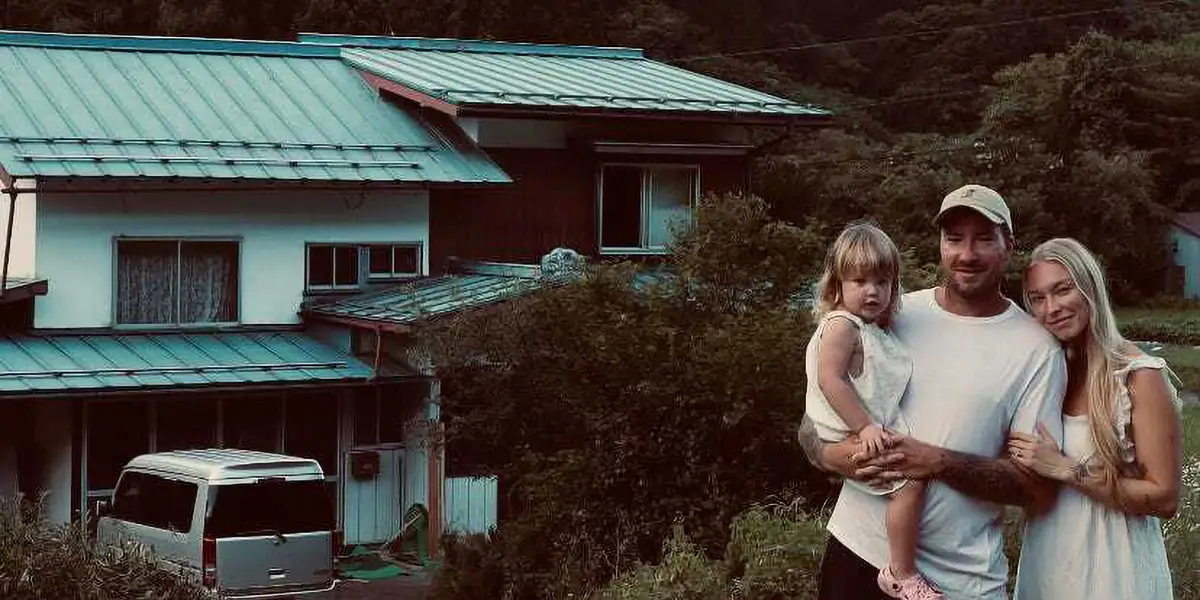
This as-told essay is based on a conversation with Lloyd Enbom, 40, a content creator who bought an abandoned house in Hakuba, Japan, a ski resort in Nagano Prefecturewith his wife Mandy Rutherford. Enbom, who is from Australia, plans to continue traveling with his wife and two-year-old daughter and make Japan their home for six months. The following has been edited for length and clarity.
We did YouTube full time for almost five years. Our full-time work consists of travel content.
In 2021, we were locked down in Australia until November 11, the very day we left.
At the time, many people, especially in Australia, thought this was not possible travel to Bali or Southeast Asia, so we documented our experiences with it and shared tips and advice. That’s when it really dawned on us that travel content was a viable business because people tend to watch other people travel to get advice on where to go, what to do, how to get visas and how to make money online, so you travel full time.
So we fell into the role of educators for people on how to live this kind of life.
We started in Bali and then traveled through Southeast Asia. We visited all of Vietnam in one month, which was absolutely incredible; we went to Thailand, Singapore.
Then we went to North America; we spent six months in Mexico, and then we bought a camper and went on a trip around basically the entire western United States. We drove our camper through Idaho, Montana, Wyoming, Utah, Nevada, California, Oregon, Washington and back again. We got married in Las Vegas and had our honeymoon in New York City.
Then us settled in Thailand for two years, where we had our daughter Lyla.
Lloyd Enbom and his wife are largely nomadic, but they plan to live in Japan for six months. Thanks to Lloyd Enbom
We had achieved what we wanted: to have a full-time income and to live wherever we want. We decided Thailand would be a very good option for us as digital nomads; it’s cheap, has really good healthcare and great private hospitals that are cheap.
We rented a place in Thailand, but as foreigners you cannot own land in Thailand. You must rent a home for 25 or 30 years. When you buy a house in Thailand, you are essentially renting the land on which you live.
It works for some people – many retirees go and do the long-term leasing thing, and I think it works out pretty well financially. But we were in Thailand and Mandy started seeing these cheap houses in Japan when she was pregnant.
Apart from that time in Thailand, we were completely nomadic. It’s great to be able to move, but the biggest challenge is you live out of a suitcase. At some point you really start longing for a home base, a place to return to, and that’s one of the things that led us to buy a house in Japan.
We fell in love with a Japanese ski town – and the cheap houses
When we were in Thailand, we went down a YouTube rabbit hole. We learned a lot, and the more we learned, the more we realized that buy a house in Japan was actually quite possible.
My first concern was, “How are we going to buy a house if we don’t have a residence permit in Japan?” In most countries – such as Thailand – you must be a resident to buy a house.
The biggest surprise was that you don’t even have to set foot inside Japan to buy a house there. If you find the right house and the right real estate agent, you can buy a house from your home.
We read up on it and went back and forth on the idea for two years. In March 2026 we came to Japan on a road trip and decided to look at some houses. We decided then that it was pretty much a no-brainer for us.
We ended up finding a house within 15 minutes of an amazing ski resort called Hakuba. They co-hosted the 1998 Winter Olympics there. There are a lot of Australian expats who come to snowboard here and end up staying, so it has a bit of a multicultural vibe.
It’s still very Japanese, but it doesn’t feel that way you are such an outsider in a ski town like this. When we found it, we thought this could solve a lot of our problems.
We were fortunate enough to have someone selling this property we were interested in, and the agent had once lived in Canada, so she was Japanese, but spoke fluent English.
The property was for sale a month earlier and we happened to be traveling here, so we emailed them and were able to arrange a viewing, and everything went pretty smoothly.
The total closing price was 3.6 million yen, $22,000 at the time. After all the fees we had to pay, the total was 4.1 million Japanese yen.
We signed everything at the end of March 2026 and they gave us about five months to actually complete it, which was great because we had to sort out all the paperwork and logistics. We moved in July.
I don’t want to sugarcoat it and make it look like you’re buying a $20,000 completed house where everything is in order. There are many things you have to take on yourself.
When we signed the contract to buy the house, we bought it as is, which means if the electricity doesn’t work or the water pipes are all rusted and such, that’s our responsibility. We have to solve that.
We didn’t know if we would have running water or electricity, or if anything would work. Fortunately the electricity and water did. But the boiler didn’t work, so the most important thing for us at the moment is to take a hot shower and renovate the bathroom.
The bathroom is just a cold bath at the moment, which doesn’t really work when a two year old and two adults live there.
The kitchen before the renovation. Thanks to Lloyd Enbom
We expect to spend about the same amount on renovations as we spent actually purchasing it. We can even go further if we really want to make it fun.
We want to keep traveling, but Japan will be our home base
This is only our second time in Japan. We came this spring for a road trip of about a month and we fell in love with the country.
The culture is extremely friendly and polite. It’s clean, it’s safe, it has four seasons, and it is surprisingly affordable. You can eat out in Japan for half the price we pay in the United States or Australia.
We’re not going to do that live in Japan full time. There is a difference between purchasing a property and obtaining citizenship or residency.
Our visa status allows us to stay in Japan for up to six months per year, which has always been the lifestyle we prefer; being able to travel between two places – whether that’s Thailand or Bali for six months, and then Japan for six months.
One of the bedrooms. Thanks to Lloyd Enbom
We are here and treat it like a permanent vacation home. We can come and enjoy the surroundings and our house that we own, which we have renovated ourselves and which contains our furniture. We don’t have to find a new rental every time we want to come back here.
We own forever in Japan for the price of what wouldn’t even cover the down payment on a house in Australia. And no one can ever take it away from us.