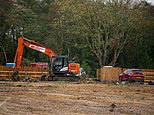
A group of travelers have been ordered to leave an illegal site opposite one of Britain’s largest nuclear weapons factories, a High Court judge has ruled.
The group had built thirteen static houses on land opposite the Aldermaston site of the Atomic Weapons Establishment (AWE) in Berkshire by 2025.
Last year, ‘concerned’ local residents said they were ‘feared for their safety’ and had called on their council to intervene and stop the group’s construction.
Hundreds signed a petition after construction began next to the sprawling campus, the largest of three sites where Britain makes nuclear warheads.
West Berkshire Council had issued a temporary ‘stop notice’ to developers when an application for the work was submitted in November 2025.
However, this was later ignored and construction continued on the site without permission, a spokesperson confirmed last December.
Now a judge has found that families ‘flouted’ a court order after deliberately entering the land.
The judge added that allowing the families to remain on the land after violating the order would render future orders “completely toothless.”
The High Court has ordered a group of travelers to leave an illegal site opposite the Aldermaston site of the Atomic Weapons Establishment (AWE) in Berkshire.
The group had built thirteen static houses on land opposite the Aldermaston site of the Atomic Weapons Establishment (AWE) in Berkshire by 2025.
West Berkshire Council had issued a temporary ‘stop notice’ to developers when an application for the work was submitted in November 2025, but work continued
Despite the order, one family remains exempt from the ruling as they lived on the property before the order was served.
Other residents were given 28 days to leave the country, judge Sylvia de Bertodano ruled. October 5 was given as a likely departure date.
However, a final deadline remains dependent on further submissions.
The court heard the development could put pressure on crucial emergency facilities designed to protect local people in the event of a nuclear accident.
The judge expressed her sympathy for the difficulties faced by the defendants and other members of the traveling community in finding locations for permanent homes.
“However, it cannot be right that if they flout the orders of this court, they will succeed in defeating their purpose,” she added.
It comes after a temporary halt was issued by West Berkshire District Council in November 2025.
After work continued, the municipality obtained an order on December 18, which was served the following day.
The order restricted occupation of the site and further works, with the exception of a caravan occupied by one family.
The order continued into January, but the ruling shows that work continued and the site grew to accommodate families in at least 22 separate locations.
The travelers tried to change the order, arguing that families were living there before it was granted.
They also said the original order was issued on the basis of incorrect facts and without due consideration of their rights under Article 8 of the European Convention on Human Rights.
The group wanted to stay until their planning application was finally determined.
However, the judge rejected their testimony about when they had moved, preferring the council’s evidence.
The council had photos showing extensive construction activity, but there was little evidence the group lived there.
The judge called the residents’ evidence about their appeal ‘completely unconvincing’.
She found that “in any case it is not supported by any convincing documentary or photographic evidence.”
A High Court judge has now found that families ‘flouted’ a court order after deliberately entering the land
She also said that apart from one family living on the property as of December 19, 2025, all others who had moved onto the land had breached the order.
The illegal site caused problems for AWE Aldermaston due to its proximity to the nuclear weapons factory, the court heard.
Tom Bennington, a senior official at the Defense Nuclear Organization, indicated that the site was already under significant pressure.
He added that as population density increases, pressure on the site also increases, jeopardizing the operation of the critical facility.
An AWE witness, identified in the judgment only as AE, said caravans offered less protection than brick buildings.
They also added that the development brought vulnerable people close to the nuclear facility without adequate shelter.
Carolyn Richardson, who manages the joint emergency planning unit for three municipalities, told the court the Office for Nuclear Regulation had not declared the plan inadequate.
However, she had raised serious concerns about population growth and warned that an emergency could result in resources being diverted to the trailer park and away from long-term residents.
Meanwhile, Dr Pearce argued on behalf of residents that the actual risk was minimal as the number of additional homes was relatively small.
He said the problems with the contingency plan can be addressed by improving the plan and adding resources.
But the judge said his evidence did not significantly reduce her concerns; However, she emphasized that the nuclear emergency was not decisive in her ruling.
Regarding the off-site contingency plan, she said it was “clear” the traveler occupancy would have “concerns” for the safety of other local residents.
“I make it clear that this factor does not determine my decision, but it is appropriate that I raise this as a particular concern,” she added.
The judge recognized that families had made the land their home and took into account their right to respect for private and family life, in addition to the interests of the children living there.
But she added that it cannot be “right” to allow “children to be brought onto a property in disobedience to an order as an asset to thwart its purpose.”
The court had little or no evidence about where the families had previously lived.
The judge said that, without evidence to the contrary, she was entitled to assume that they could return to their previous accommodation while the planning process took its course.
She added: ‘It is absolutely clear that all these children are part of loving families who care for them and will continue to do so when they leave the country.
‘In these circumstances, the interests of the children have been properly balanced by the court, and the balance remains in favor of continuing the ban.’
Sixteen planning applications submitted in May were incorrectly completed and invalid, the judgment said.
There was also no valid application before the council when the matter was heard, he said.
The judge did not rule on whether planning permission should be granted, but said any application would face serious obstacles due to the location.
The verdict, pronounced on September 7, will determine the precise date of departure after further written comments.
The judge added that she would rule on the matter on September 14.
She added: ‘Defendants should be aware that the likely date on which they must cease occupation is October 5, 2026.’