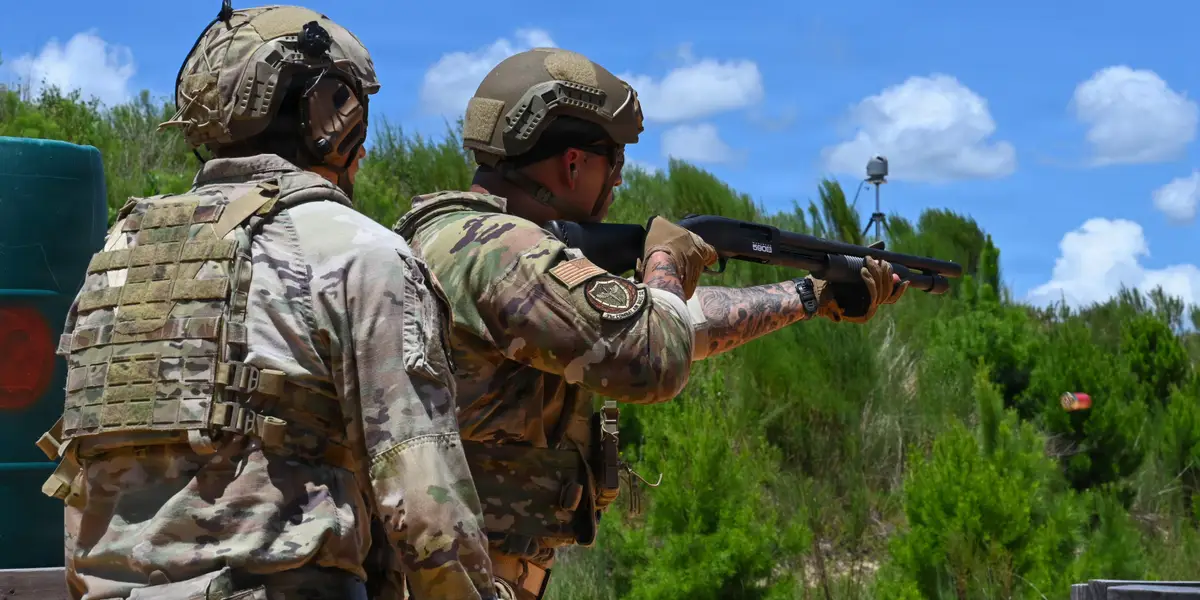
U.S. Air Force personnel recently trained in a multi-layered approach to countering drones, using artificial intelligence to spot them, electronic warfare to disrupt them, and shotguns as the last line of defense.
The recent exercise highlights the US military’s growing focus on having a variety of kinetic and non-kinetic systems defend against unmanned aerial systems. It’s a work in progress as the various services figure out what capabilities best fit their missions and what lessons can be shared across the force.
Earlier this month, the Air Force’s 31st Air Task Force tested drone defense tactics against small unmanned aerial systems, connecting different technologies to form a layered defense.
“Through a crawl, walk and run approach, pilots gained practical knowledge of a full spectrum of layering counter-sUAS capabilitiesthe 31st Air Task Force’s force protection chief said in a news release. “The ATF is committed to providing layered defense through detection, electronic warfare and physical interception of enemy drones.”
During the defensive training, pilots learned how to use AI systems to scan the sky. Those systems helped identify drones filtering out non-threats such as birds and airplanes. The personnel also trained in other weapons to defend against drones and electronic warfare threats.
As part of the exercise, small high-speed drones mimicked enemy flight patterns, giving pilots the opportunity to gain experience detecting and tracking realistic targets.
According to the press release, the exercise concluded with a live-fire element where personnel used kinetic weapons such as shotguns as a last line of defense against drones.
The layered defense approach to drones includes several non-kinetic and kinetic ways to stop them, including shotguns as a last option. U.S. Air Force photo by Staff Sgt. Ty Pilgrim
“The team successfully conducted a capstone exercise that validated new tactics, techniques and procedures in force protection and distributed communications,” Col. Brad Dvorak, 31st ATF commander, said in the news release.
“Our mission is to enable Air Force operations anytime, anywhere. By establishing an sUAS instructor cadre, we have trained our personnel in the counter-sUAS architecture and deployed unique solutions for pilots to detect, jam and kinetically defeat sUAS threats.”
The Air Force said it will review the lessons learned from the exercise.
Recent counter-drone training within the US military has pursued a similar goal layered defense approachas troops practice detecting, tracking, disrupting and ultimately defeating drones. Even in the exercises that did not specifically focus on countering drones, troops sometimes still carried shotguns or other weapons for close-range defense.
In Ukraine, where drones dominate the battlefield, both sides have deployed a range of drone detection equipment and electronic warfare systems to disrupt the radio frequencies used to connect operators and certain first-person-view drones. Some drones, such as fiber optic drones, are immune to jamming, and in those cases troops say the best available defense option may be a shotgun.
Many Western militaries are still working with best practices to address these challenges.
To make it easier for U.S. operations to acquire counter-UAS capabilities and to give units more flexibility in choosing systems suited to the threat they expect to face, the Pentagon-led counter-drone task force has introduced a new online catalog that military, federal government and law enforcement personnel can use to review validated systems – from kinetic weapons to jammers – and submit requests to purchase them.