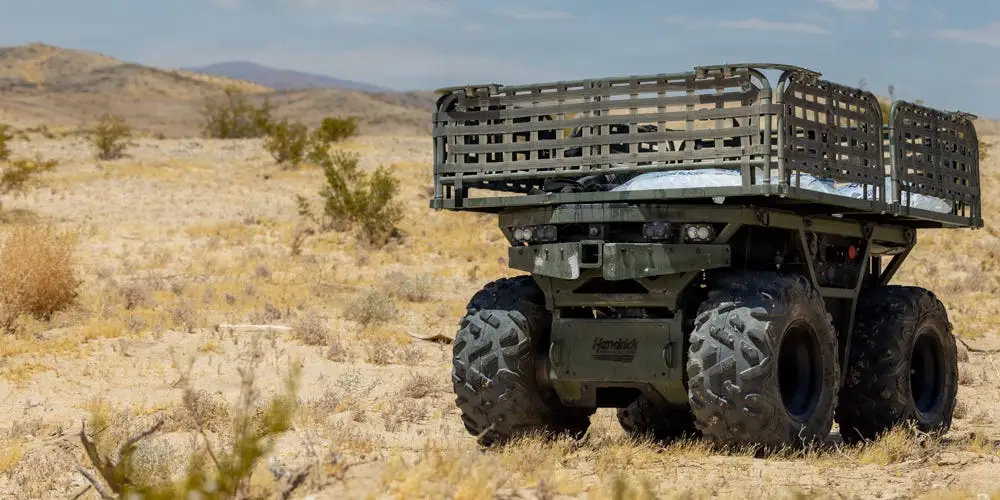
In the rocky ridges of the Mojave Desert, American soldiers recently deployed a ground robot on logistics missions traditionally carried out by humans.
The uncrewed ground vehicle (UGV) is called NOMAD and is manufactured by Hendrick Technical Solutions. Soldiers told Business Insider that these types of robots keep troops out of harm’s way, but such systems are not without limitations.
During the Project Convergence Capstone Exercise Nearly 10,000 soldiers gathered at Fort Irwin in California last month experimenting with new technologies as you fight through simulated battles. While the majority of the drones involved were unmanned aerial vehicles, some ground drones were tested and used in and around the battle.
Soldiers used the NOMAD robot primarily for supply missions, although they could potentially be involved in medical operations, such as transporting injured personnel. “We probably used it 12 to 13 times,” said Sgt. 1st Class Alex Alcantar told Business Insider, “and it’s extremely, extremely helpful.”
Alcantar said the NOMAD reduced the risk to soldiers who would otherwise have had to carry out these missions by pushing supplies forward “with minimal force.” The NOMAD system can be operated by one person via a tablet, on which the camera image is displayed and controls are included.
During the exercise, soldiers said it was easy to load supplies onto the NOMAD and took five minutes or less to set up and deploy. However, they did encounter some challenges with the system. Like most of the Army’s systems and technologies during the exercise, the NOMAD was affected by the desert heat.
“Because of the heat, that little tablet screen turns off, or a malfunction occurs,” Alcantar said, adding that he came up with a workaround by putting the tablet on ice for a few seconds. Other soldiers said they would come up with similar solutions to keep their drones and devices cool.
Soldiers found the NOMAD useful for supply missions, but acknowledged problems caused by the heat and terrain. U.S. Army photo by Pfc. Craig Kong
The terrain, particularly the mountain ridges scattered across the desert, also affected operations, reducing the NOMAD’s range from about 600 meters to about 200 meters. And unlike some non-threaded systems, there’s no “return home” function, meaning soldiers have to manually retrieve the drones if the connection is lost.
To transport the NOMAD, soldiers loaded the drone into a trailer attached to a vehicle. The trailer supplied by the military showed wear and tear due to the constant use of the robot. The trailer ramps in particular showed damage. If the ramps fail completely, soldiers will no longer be able to use the NOMAD, but even a partial failure could cause problems, soldiers shared.
In one incident, they said, a ramp failed and the bot turned on its side. Soldiers were able to get it right without any damage to the system, but the situation had made them more cautious in using it. The manufacturer did not respond to Business Insider’s questions about the robot’s performance.
The soldiers who tested drones and other technologies during the exercise gathered feedback on how the systems performed so the Army and suppliers could assess them. Army leaders said a key point of the training was to see how technologies performed in extreme conditions and then use feedback to make improvements.
The U.S. military has long viewed ground drones as robotic mules, though these initiatives have taken on new urgency as lessons from other conflicts emerge. Ukraine has achieved success in use of UGVs to transport supplies and ammunition to soldiers instead of relying on people.
For American soldiers, the new technology is fundamentally changing aspects of the way they do their jobs, but it also poses a number of challenges that they must address head-on, especially in more severe weather conditions. The goal, however, is that peacetime experiments will eventually provide sufficient preparedness in the event of a real war.