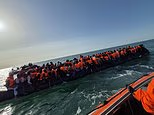
People smugglers have resorted to using larger ‘mega boats’ to transport migrants across the Channel as they no longer have small boats, a new BBC research has found.
Last month, the public was shocked by images of a huge bouncy castle packed with 230 migrants arriving in Britain overnight.
The August 10 crossing was the largest number of people ever recorded on a single small boat, breaking the previous record of 165 set just 17 days earlier.
The 230 arrivals were more passengers than the typical capacity of a Boeing 737.
The unprecedented crossing led to accusations that politicians had ‘lost control’ over illegal migration, while French police came under renewed fire for failing to intervene.
But the investigation has now uncovered another reason behind the sudden rise of these mega dinghies: smugglers are running out of smaller vessels.
This is largely due to the success of law enforcement efforts to disrupt equipment supply chains.
With fewer boats available, rival criminal groups that would once have operated separately are now forced to work together, cramming larger numbers of migrants onto fewer, larger ships.
The public was shocked by images of a huge bouncy castle filled with 230 migrants arriving in Britain
Gang members have reportedly revealed that more of these huge boats are already being readied, raising new concerns among emergency teams on both sides of the Channel about the increased risk to human life.
The dangers were highlighted on August 4, when 170 people had to be rescued after their dinghy caught fire in the middle of the Channel.
And with French authorities claiming to intercept two-thirds of small boats before they can reach shore, that means fewer crossing options.
And for migrants hoping for a spot on a boat, it means paying a higher price.
Traffickers are currently believed to charge around £2,000 per head for illegal passage into Britain.
With around £10,000 in assumed costs for the trip, the megaboat crossing on August 10 could have made them a staggering £450,000 in profits.
These new mega-rubber boats are ‘floating death traps’ and at 12 meters they are longer than a double-decker bus.
Former Chief Inspector of Borders and Immigration David Neal said: “Organized crime gangs are highly adept at circumventing measures put in place by law enforcement.
“If the police manage to close a road through which smugglers obtained rubber boats and maritime equipment, the gangs will immediately switch to other manufacturers, import routes, and so on. Dealing with organized criminals is a constant game of cat and mouse.
‘The use of oversized rubber boats suggests that traffickers have changed their tactics in this way. They have probably found a new manufacturer who now makes these larger boats to order.
“It could even indicate that law enforcement’s success in seizing outboard motors is causing the boats to keep getting bigger. In other words, they have fewer engines and so use them to power a smaller number of larger dinghies.’
He added that these gigantic boats pose a great danger to life, due to the risk of people drowning, being trampled and crushed.
“Authorities may even be more reluctant to approach such vessels at sea as the wake created by patrol boats would risk destabilizing these already overloaded unseaworthy dinghies,” he said.
This prospect of mass drownings keeps home ministers awake at night.
Previous incumbents have spoken privately about the guilt they felt after the Channel deaths, questioning whether they could have done anything to prevent the loss of life.
Neal said, “Human traffickers are concerned only about their profits and are indifferent to the safety of the migrants they smuggle. They will gather increasing numbers of migrants into these deadly rubber boats just to make money, with potentially disastrous consequences.
‘Overall, the very meritorious aim of targeting organized crime gangs and their supply chains may have had the unintended side effect of making the Channel crossings even more dangerous.’
However, it remains to be seen whether these mega dinghies will prove as effective as the smaller boats, with Channel crossings reaching a six-year low this summer.
Nearly 7,000 people made the journey in small boats between June and August.
Migrant arrivals on small boats fell to their seasonal lowest since 2020, with 6,949 migrants crossing the Channel in the three summer months. The number of boats arriving in Britain has fallen to the lowest level since 2019.
While critics have attributed the decline to bad weather, Interior Minister Shabana Mahmood attributed the decline to increased international cooperation that blocked people smugglers’ supply chain for boats, lifebuoys and outboard motors.
Mega boat full of migrants would carry 165
A patrol boat hands over life jackets to a raft at Gravelines, near Calais
She also credited a £662m deal with France to put more officers on beaches and adopt new interception tactics.
A total of 16,391 migrants have crossed from France to Britain so far this year, a fall of 43 percent from the same period last year, and an 18 percent drop from the same period in 2024.
Ms Mahmood said: “This government is committed to restoring order to our border. This work is beginning to pay off: June, July and August recorded the lowest number of small boat crossings in seven years. But we know there is more to do.
“We will be ruthless in attacking the criminal gangs behind these crossings, and we will continue to remove the incentives that draw people here via unsafe and illegal routes.”
Small boat crossings will be one of the key issues discussed when Andy Burnham hosts French President Emmanuel Macron in Issue 10 for the first time, according to officials.
The Prime Minister will be keen to continue the one-in-one-out scheme with France, which is designed to deter crossings.
The two leaders are expected to announce plans for a new French police ‘surge team’, funded by Britain, to tackle the increasing use of ‘mega dinghies’, which can carry up to 230 migrants.
The two leaders are expected to confirm that the total number of French police officers tasked with stopping the boats has reached the 1,000 mark for the first time with the creation of a 75-strong specialized unit.
A ‘surge team’ of 45 officers will be deployed to the western beaches where criminal gangs launched huge, dangerous rubber boats this summer.
The ‘one in, one out’ deal has led to the removal of around 1,400 illegal migrants to France, while a similar number of legitimate asylum seekers were allowed to travel to Britain.
Despite the small numbers involved, Number 10 yesterday insisted the deal was an ‘important step in the right direction’.
Mr Burnham said: ‘The progress we have seen this summer shows what can be achieved when Britain and France work together.
“But it is clear to me that we cannot be complacent. Smuggling gangs are constantly adapting their tactics, and Britain and France must respond quickly and stay one step ahead of the criminals facilitating the dangerous crossings.
‘The small boat crisis is a shared European challenge, and no country can solve it alone. “By working together with France and our international partners, we will restore order and control at our borders and prevent smugglers from exploiting vulnerable migrants.”