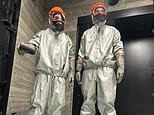
In a civil defense shelter cut into the rock, behind doors designed to withstand a nuclear or biological attack, two Finnish conscripts, dressed in protective suits and breathing masks, measure radiation levels as they take part in an exercise to turn a cave into a safe place for thousands of people.
Inside, in what is normally a sports hall, hundreds of people sleep on trestle beds at night.
More than 2,000 people, including volunteers and students, are taking part in the largest civil defense exercise in Europe since the end of the Second World War.
In the scenario, critical infrastructure in the central Finnish city of Kuopio, including power and water, has been disrupted by cyber attacks and there is the threat of missile attacks from Finland‘s neighbor, Russia.
The aim is for local authorities and ordinary people to rehearse what they would do if they were really attacked.
But while underground bunkers and shelters may provide some protection against missiles, they are no defense against the campaign of sabotage and disruption that Western officials say Russia is waging across Europe. That included setting fires, attacking water facilities and power plants and sending drones for sabotage European Union airspace.
Finland’s border with Russia extends over 1,330 kilometers, from the Baltic Sea to the Arctic Circle. In 2024, together with SwedenFinland joined NATOfollowing the example of the Russian president Vladimir Putin‘full size invasion of Ukraine. Until then, the Finns were prepared to defend themselves against Russia largely alone.
The Finnish defense, according to retired army colonel Asko Muhonen, relies not only on the army, but also on the “mentality” of ordinary Finns who are willing to take responsibility for their country’s security.
Finnish conscripts measure radiation levels in a shelter in Kuopio, Finland, during a civil defense exercise Wednesday, September 2, 2026
People sit in a shelter designed to resist chemical, nuclear and biological attacks during a civil defense exercise in Kuopio, Finland, Wednesday, September 2, 2026
Muhonen, who organized the exercise in Kuopio, said this partly stems from the conscription system that persisted in Finland even after the collapse of the Soviet Union.
Not everyone is happy about doing national service, but ‘it is our duty to serve and protect this country as the people before us have done. That’s why we have our independence,” said Jyry Pietikainen, 23, a conscript who learned overnight how to run the Kuopio shelter.
Finland should also learn lessons from Ukraine, Muhonen said.
While the largest shelter in Kuopio can hold 7,000 people, Ukrainians sometimes have only a few minutes to run to a metro station or an underground parking lot. That means people need a shelter that they can easily reach and that offers some form of protection — not necessarily one that can withstand a nuclear attack, he said.
Dmytro Untila, 20, a Ukrainian university student in Kuopio, was at home in Odesa when Russian missiles struck his city on February 24, 2022, the first day of the war. He took shelter in the hallway of his building because he had nowhere else to go, he said.
Training for such a situation would certainly have helped in Ukraine, he said, “because no one knew this could happen.”
The biggest threats to the energy infrastructure in the Kuopio region are heavy snowfall, storms and bad weather, says Juha Räsänen, CEO of the electricity company Savon Voima.
But since the invasion of Ukraine and the company’s decision to stop buying Russian biofuel, the number of cyber attacks against the network has increased significantly, Räsänen said.
Last year, engineers also found at least ten stickers placed on particularly vulnerable parts of the energy network infrastructure. Other energy companies in Finland have also found them and don’t know where they come from, he said.
“If an explosion were to happen at that moment, it could destroy an entire dam,” Räsänen said. Drones have also been spotted flying over power lines, but those responsible have not yet been identified, he said.
People attend the Shelter 2026 civil defense exercise in Kuopio, Finland, Wednesday, September 2, 2026
Participants play cards in a shelter during the Shelter 2026 civil emergency and defense exercise in Kuopio, Finland, on September 2, 2026
It is not possible to protect against all threats, Räsänen said. That’s why it’s important that people are prepared to care for themselves unaided for at least 72 hours – if the power supply goes out or if the water becomes undrinkable.
Finland’s Security and Intelligence Service said it investigated “a wide range of observations” and found nothing of concern.
Since 2022, people have been more vigilant due to the security situation and have therefore reported issues such as reflective stickers related to surveying work, a statement said. Drone sightings, the report said, are “largely explained by everyday occurrences.”
“Little things happen all the time,” including Russian interference with GPS signals, said Vuokko Lahtinen, 32, who was visiting a sauna in Kuopio.
For that reason, “Finland’s best defense is to make the country not worth attacking,” she said.
That depends on the country’s military and defense, but also on Finns feeling that “we have something we want to fight for,” she said.
In Finland, she said, there is a “general sense of responsibility,” which has emerged from local community groups and even initiatives such as recycling.
“On a very simple day-to-day level, when you do things that matter, it has a butterfly wing effect,” Lahtinen said.
In its wars with the Soviet Union, Finland lost about 11% of its territory, and more than 400,000 people, about 12% of the population, fled their homes from an area that is now in western Russia.
At Kuopio’s veterans museum, Risto Mönkkönen, 95, showed AP a piece of paper on which he had written down the dates the city was bombed and who died.
People lie on portable beds during the Shelter 2026 civil defense exercise in Kuopio, Finland, Wednesday, September 2, 2026
People stand at the entrance of a shelter designed to resist chemical, nuclear and biological attacks during a civil defense exercise in Kuopio, Finland, Wednesday, September 2, 2026
“I can’t forget it,” he said, explaining how as children he and his father stumbled upon a bomb shelter just as a bomb hit, killing five of his father’s friends.
Pirkko Naukkarinen, 102, recalled how at age 16 she worked in a field kitchen on the front lines, sometimes sharing shelters with soldiers and taking cover in ditches as the Soviet air force attacked the retreating Finnish army.
Aili Toivanen, 92, told AP that she had to leave her home twice because of the various wars. Both times, her family was told by Finnish soldiers that they had an hour to pack their belongings.
The first time she looked back and saw her house burning – set on fire by Finnish soldiers who didn’t want to leave anything behind, she said.
The second time, she said, the Soviet air force bombed the family’s departing train and they jumped out and hid in ditches before taking refuge in Kuopio.
When Putin invaded Ukraine in 2022, she said with tears in her eyes that she feared she would have to leave her home for a third time.
Thousands of people arrived at the reception center in Kuopio, including school and university students.
‘Kids should know this because they may have to do something on their own. The adults can’t always help,” said Amanda Hill, 11, whose school day was at the shelter.
Participants knit in a shelter during the Shelter 2026 civil emergency and defense exercise in Kuopio, Finland, on September 2, 2026
People enter a shelter designed to resist chemical, nuclear and biological attacks during a civil defense exercise in Kuopio, Finland, Wednesday, September 2, 2026
Sitting on the floor of the shelter, Pietikainen explained with his fellow conscripts why it is not crazy to practice what happens in a crisis.
“We are Finns, so in a way we are quite pessimistic about life,” but history shows what can happen to Russia, he said.
When it comes to threats from Moscow, Muhonen said, “don’t believe what they say, observe what they do.”