Some days life goes your way. Other days, AI steals another client from your content marketing roster while your French bulldog is undergoing treatment for a $2,500 corneal ulcer and the first rent is due.
So when times are tough, I’ve found that saying “no” rolls off the tongue quite smoothly – to fancy dinners, concert tickets and, most disappointingly, international travel.
That was, until an offer came along Visit Japan fell into my lap for the first time. So against my better judgment, I said yes and joined a group of American women invited to learn more about two lesser-known regions in Japan: Toyama and Ishikawa Prefectures.
Embracing the local culture
After eight days of traveling and eating through Tokyo, Osaka and Kyoto, I hopped on one high speed train to Toyama Prefecture, about 190 kilometers northeast of Kyoto.
Toyama immediately reminded me of the lush and scenic Pacific Northwest. And just like the PNW, there is a strong local culture around food, enjoyment and art. In fact, I unexpectedly discovered an exhibition by renowned Washington glass artist Dale Chihuly in a glass museum.
During my three days in Toyama, food was an important part of the experience. My first omakase lunch consisted of endless rounds of sushi dishes with fresh seafood from Toyama Bay – I squeamishly devoured a head-to-tail fried ayu sweet fish.
During my three days in Toyama, food was an important part of the experience. Provided by Tracy Block
The next day brought an excursion to a whiskey distillery in Tonami, about 40 minutes west by car, including a tour (I was surprised to hear they use barrels imported from Kentucky) and a Japanese whiskey blending experience. While I am by no means a whiskey connoisseur, I enjoyed learning about the science.
I’ve enjoyed fine dining with Michelin stars in Miami for many years, but my last lunch at L’évo in Nanto, a scenic hour-long drive southwest and a restaurant awarded two Michelin stars in 2021, was just as memorable. I hesitantly tried the local black bear and soft-shelled turtle – although delicious, the latter left me feeling a little guilty.
Discovering the slow side
We then ventured by high-speed train to Kanazawa, 40 miles southwest of Toyama. Over five days in Ishikawa Prefecture, I slowed down and spent time with local artisans who are committed to preserving their crafts.
In Kanazawa I visited the home of a master instructor from the samurai lineage. I stood in awe, nervously holding a 200-year-old sword from the Edo period.
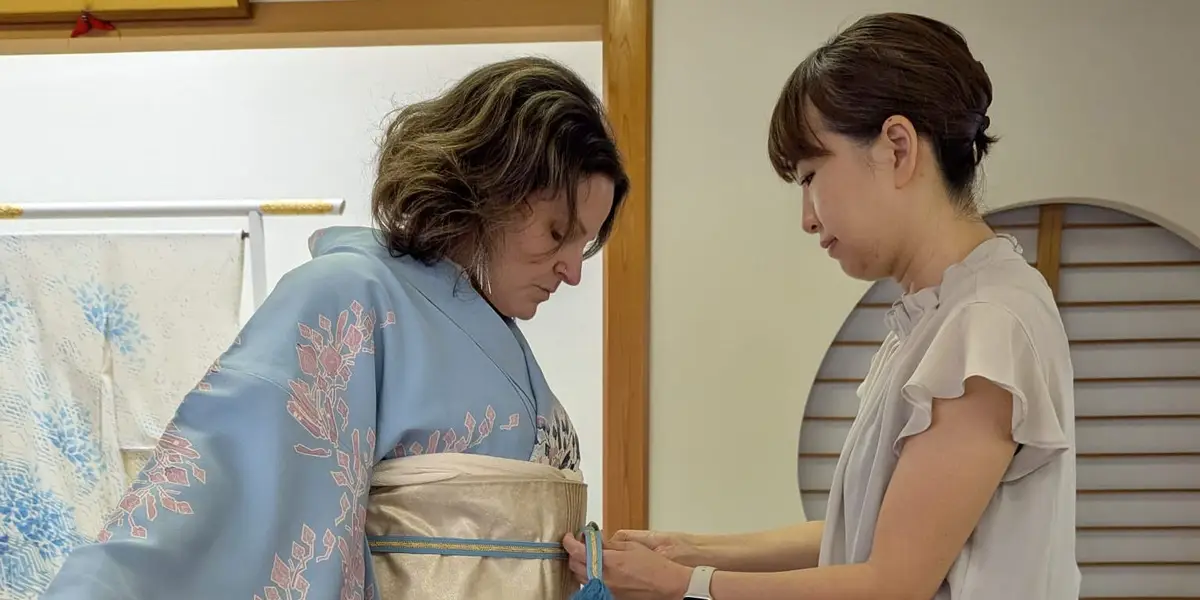
My inner Black Mamba (circa “Kill Bill”) kicked into action when I was asked to put on a uniform and wield one. I also went to a three-generation kimono workshop to see the makers behind the scenes, and I carefully but kindly tried on a $30,000 vintage kimono – it was one of the highlights of my trip.
From Kanazawa I ventured to Kaga for the first time traditional ryokan staywhere sleeping on tatami mats instead of a mattress wasn’t as uncomfortable as I expected.
I also visited the homes of several local artisans. First I met an artist and washi papermaker whose husband taught ikebana, the Japanese art of flower arranging. Working with flowers from the surrounding grounds was much more invigorating than visiting Trader Joe’s, my typical supplier. The duo reminded me of couples I might have encountered during my years living in Colorado.
Tracy Block traveled to Japan for the first time and visited lesser-known parts of the country. Provided by Tracy Block
After Kaga, I ventured to nearby Nomi City, home to a porcelain master, whose daughter, Reiko, guided me through the more patient art of red painting with fine lines. Although I love crafting, I prefer to color outside the lines.
At the end of the trip I returned to Kanazawa to begin the journey back home. Although I was tempted, I couldn’t afford to treat myself to the $30,000 vintage kimonoso I splurged on a $130 soft hotel coat and a $17 rooftop cocktail instead.
After all, a compromise can still be a disguised version of ‘yes’.