IranAyatollah Mojtaba Khamenei has all but disappeared from public view, fueling fevered speculation in Tehran that the Islamic Republic is hiding the truth about who really runs the country.
Mojtaba was appointed Iran’s new supreme leader on March 8, a week after joint US-Israeli airstrikes killed his father Ali Khamenei on February 28.
He was on site in Tehran when it was hit. Sources close to Mojtaba’s inner circle later told Reuters that the blast left his face disfigured and caused serious injuries to one or both legs.
However, since his accession to leadership was announced months ago on state television, no one has seen or heard from the ruling ayatollah, including his ministers.
Mojtaba’s string of absences extended to his own father’s funeral on July 5, where three of his brothers were captured praying next to the coffin of the late supreme leader.
Rumors of his alleged death have since reignited after Mojtaba organized a vigil for his predecessor and father last Tuesday.
Thousands filled Tehran’s largest mosque, including the country’s most powerful political figures and several sons of the late Khamenei.
Iranian officials claimed that Mojtaba organized the event, but he was not among those who attended.
It is now clear that several of the country’s political leaders have not even caught a glimpse of the new supreme leader.
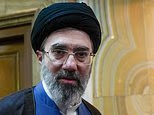
Iranian Ayatollah Mojtaba Khamenei attended a meeting in Tehran in October 2024
A photo of Mojtaba is displayed in a shop at a local market in Bandar Abbas, Iran in August 2026
London-based Iranian outlet IranWire reported that no cabinet member has met Mojtaba since he came to power five months ago.
His invisibility has led to rumors among the ‘highest levels of the regime’ that he is in extremely critical condition and that his death is imminent.
Such speculation is fueled by Mojtaba’s failure to make public appearances or make speeches, with all correspondence limited to a few letters published by official news agencies.
A source close to Iranian President Masoud Pezeshkian’s office confirmed that no cabinet meetings have been held with Mojtaba so far, but described his physical condition as very poor.
“We would not be surprised if we hear news of his martyrdom soon,” they said.
Meanwhile, some believe that Mojtaba was left brain dead after the attacks.
Earlier this month, a public appeal circulated on an Iranian messaging service, calling on people to pray for Mojtaba’s health and sacrifice a sheep on his behalf, as part of Islamic traditions.
The call stated that Mojtaba’s “life is in danger,” according to a group of clerics.
Mojtaba is apparently captured speaking during a session in Tehran, released on August 24, 2026
This followed the agency’s most recent statement on August 9, which claimed that Mojtaba had met with President Pezeshkian.
After the meeting, which is believed to have taken place in late July, the paramilitary leader promised that images of Khamenei would be released in the future.
According to Qasem Qoraishi, deputy of the Basij organization, this would include videos of Mojtaba among the public and walking on the streets, as well as with commanders of the armed forces.
Meanwhile, at the same meeting in August, Mojtaba reportedly issued numerous decrees, promoted several generals to high military positions and moved around members of his National Security Council.
This came after President Pezeshkian said meetings with the supreme leader were “increasing day by day,” but said in early August that communicating with Mojtaba was “very difficult.”
It comes as the Daily Mail previously detailed three theories about Mojtaba’s whereabouts.
“The first theory is that Mojtaba is alive and well, and he is running the war from a bunker,” said special correspondent David Patrikarakos, who had spoken to Western intelligence sources.
‘This is the line that Iranian officials are expressing. President Masoud Pezeshkian recently claimed that Mojtaba is on the mend.
‘This theory holds that Mojtaba survived the bombing of his family largely unscathed. I think we can dismiss this as nonsense. That is clearly not the case.
‘The second is that Mojtaba fled to Russia. Russia has a long and ignoble tradition of hosting foreign psychopaths. Right now, Bashar al-Assad, the ostrich-necked tyrant, is in Moscow, where he apparently spends hours playing video games.
‘I don’t believe this either. The Iranians are not fleeing. People said Khamenei would flee, I knew Khamenei would die in Iran. So I think we can reject this too.
‘The third theory is that he is barely alive, possibly incapacitated and that his statements are actually being made by someone else. Most likely Ahmad Vahidi, Commander-in-Chief of the Revolutionary Guards.
No one has seen Mojtaba since his accession to leadership was announced on state television five months ago
“This makes the most sense: If he was dead, I think they would probably just say it.”
Mojtaba’s disappearance has left the Iranian regime in disarray, with its supreme leader holding the majority of constitutional power in the Islamic Republic.
As a result, Iran’s 13-member National Security Council has taken control of the country’s governance.
Opinions are divided about the direction of the war with America. On the one hand, the chairman of the council, President Pezeshkian, supports an end to the war, backed by Mohammad Bagher Ghalibaf, who has led the talks with the US.
On the other side, however, is General Ahmad Vahidi, who is the head of the Islamic Revolutionary Guard Corps.
In June, all but one member voted in favor of Iran’s memorandum of understanding with the US in Pakistan.
Mojtaba approved and supported the deal, which was given in a written statement.
However, his approval came as he said he had a “different view” on the deal, but granted approval after President Pezeshkian pledged to protect “the rights of the Iranian nation and the resistance front.”
They also accepted responsibility for the deal.
However, the interim peace agreement, or the Islamabad Memorandum as it is known, quickly collapsed.
Despite progress in the latest peace talks, unrest in the region has continued – although there have been no major strikes by either side for weeks.
Previous Iranian attacks and threats to shipping have already halted most traffic through the Strait of Hormuz, largely cutting off a waterway that carried about a fifth of the world’s energy before the conflict.
Although some oil tankers have passed through the strait in recent weeks, volumes remain very low and on Sunday Iran blacklisted 45 tankers that it said did not comply with the rules it wants to impose on Hormuz shipping.
Meanwhile, Tehran’s Houthi allies have restricted shipping in the Red Sea with attacks and threats to block all Saudi Arabian shipping, which carries crude oil to Asia through the Bab el-Mandeb Strait past the group’s Yemeni stronghold.
Although the attacks initially stopped only a few ships, with more than half still passing through as of mid-August, the situation is difficult for shippers, according to industry sources, as Chinese shipping companies are now rerouting from Bab el-Mandeb.
Iran has also threatened to retaliate against any neighboring countries that join US efforts to strangle the country’s economy with “earthquake force.”
During the war, the country has repeatedly targeted the Gulf states and Jordan, mainly targeting U.S. bases, but also energy infrastructure and other targets.
The attacks on oil and gas facilities have helped drive up energy prices and are a means of inflicting political and economic damage on President Trump’s administration.
There were recent attacks in the region on Monday on a ship off the Saudi Red Sea’s main oil terminal in Yanbu, with another drone strike near the Suez Canal in early August.
Outside the Middle East, Tehran has hit the West with cyberattacks, most recently with Iran-linked hackers shutting down a small electricity substation in Britain, the British government said.
US officials have said Tehran was also likely behind cyber attacks on water plants in Minnesota. Iran has not commented on these allegations.
Nearly six months have passed since the US and Israel launched attacks on Iran. Thousands of people have died, most of them in Iran and Lebanon.