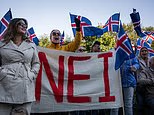
Why was anyone surprised? Iceland is a prosperous and successful country. It had nothing to gain from joining the declining EU.
A country with a proud and centuries-old parliamentary tradition does not lightly submit to a supranational technocracy. The country with perhaps the best managed fish stocks in the world will not surrender to a bloc that has drained its own seas.
Icelanders voted 52.8 percent to 47.2 percent not to resume accession negotiations with the EU. They made their first application in 2009, in the wake of the banking crisis, which hit Iceland hard.
But they dropped it in 2015, when it had become clear that Iceland had recovered from the financial crisis much faster than the EU, largely because it was wise enough not to bail out its banks.
I never had any doubts about the outcome. I know Iceland well, having been a regular visitor to that stretch of cold, black tundra since I was 19. I consider the leaders of the ‘No’ campaign to be good friends and I see the country as a second home.
I have often stood on the site of their first parliament, the Thingvellir. Icelanders from all over the island used to gather there, riding their sturdy horses over black lava fields and bright green moss, and meet each other as a free people.
In some ways they are different from us. Few of them have surnames, they build their roads to avoid elven hills – said to be the homes of magical creatures – and their language has changed little in a thousand years. But they are like us in their stubbornness.
Icelanders voted 52.8 percent to 47.2 percent not to resume accession negotiations with the EU
Icelandic Prime Minister Kristrun Frostadottir speaks in Reykjavik after the referendum results were announced
They hate being told what to do, especially by foreigners.
I was unusual in predicting a ‘No’. Opinion polls showed the pro-EU side with a small but consistent lead, and as the votes came in, wide-eyed Europhiles, buoyed by the early results from Reykjavik, became excited.
Why? Because deep down they think that European integration is inevitable, just as Marxists used to believe that socialism was inevitable. Take away the sense of relentlessness and the flaws become painfully visible.
There is little enthusiasm for EU membership, except among the impoverished states of southeastern Europe, such as Montenegro, Macedonia and Moldova. Even Turkey has lost interest in joining. In Norway, polls show that opposition to membership has risen to around 70 percent.
In these countries, EU membership is viewed purely in terms of costs and benefits. In Britain, a culture war continues ten years after the 2016 referendum. A tangle of Continuity Remainers who don’t know much or care about what’s happening in the EU are still obsessed with overturning the result of our own referendum.
Why? Because for them it is less about the EU than about defeating an imagined domestic enemy, a caricatured racist.
They have been committed to their realignment for a decade, despite the EU passing much stricter immigration laws than Britain, because they are anti-Eurosceptic rather than pro-Brussels.
It is true that Iceland has a closer relationship with the EU than we do. Membership of the European Economic Area means the country is part of the single market for everything except agriculture and fishing – although, importantly, Iceland is outside the customs union and has signed several trade agreements that the EU does not have, including with major economies.ch as China and Indonesia.
There are arguments for bringing Britain closer to the single market. But it must be done in a ruthlessly calculating way, only signing up for things when there are clear mutual benefits, rather than approaching the conversations in a spirit of contrition and reconciliation. Unfortunately, as the reaction here to Iceland’s welcome decision shows, we are still a long way from that.
Yet the question remains. If a nation with a population as large as Croydon’s is content to take its chances alone, what are we so afraid of?
- Lord Hannan of Kingsclere is an independent peer and director of the Institute for Economic Affairs.