Thousands of sea creatures have been captured on camera in a miraculous gathering of endangered sea creatures just miles away Massachusetts.
Scientists were on a research plane near Cape Cod on August 16 when they spotted more than 2,000 animals from 15 different species splashing near the ocean’s surface.
This diverse group gathered in the Northeast Canyons and Seamounts Marine National Monument, a large protected stretch of ocean about 130 miles from the U.S. with deep underwater canyons and mountains.
It is believed that the wild scene was likely a feeding frenzy as giant packs converged on this area to take advantage of an unusually rich food supply created by the canyons and mountains.
The plane’s crew, from the New England Aquarium, saw nearly 1,800 dolphins of four different species swimming in a huge pod, likely hunting for squid.
Meanwhile, endangered fin whales, humpback whales and an extremely rare blue whale all filtered the water for krill and other small zooplankton.
Researchers raised concerns about the safety of the endangered species in the hidden ocean habitat, noting that the federal government rolled back some fishing restrictions in the zone earlier this year.
Katherine McKenna, associate research scientist at the aquarium’s Anderson Cabot Center, said, “Seeing a variety of endangered and threatened species actively feeding in the Monument was particularly memorable and underscores the importance of protecting this productive habitat.”
Hundreds of dolphins at the Northeast Canyons and Seamounts Marine National Monument near Cape Cod on August 16
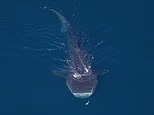
A whale shark swimming at the Northeast Canyons and Seamounts Marine National Monument
A manta ray swims alone at the Northeast Canyons and Seamounts Marine National Monument, 130 miles from Cape Cod
Researchers have spotted four different species of dolphins at the Northeast Canyons and Seamounts Marine National Monument
The April 2026 rollback on environmental protection means that the government has lifted its previous ban on commercial fishing in this protected ocean area.
Fishing boats are now allowed to catch fish there again, although some bottom dragging equipment is still restricted in parts of it to protect deep-sea corals.
Commercial boats are now allowed to catch fish, squid, tuna, swordfish and most other seafood at the Monument, raising concerns about the threat to the dwindling species and their food sources.
The Monument is a marine habitat of almost 5,000 square kilometers that was officially recognized as a protected area in 2016.
The unique underwater geography of the canyons and mountains pushes cold, nutrient-rich water from the deep ocean to the surface.
That water grows huge amounts of small plants and animals, such as plankton and krill, which attract larger animals that come to the Monument to eat them, especially in the summer months.
The crew also saw whale sharks, manta rays, devil rays, hammerhead sharks and sperm whales join the huge buffet in the North Atlantic Ocean.
‘The diversity of observations was truly remarkable and evidence of why the Monument is such a special habitat,’ McKenna added.
Map of the Northeast Canyons and Seamounts Marine National Monument
A humpback whale surfaces at the Northeast Canyons and Seamounts Marine National Monument
A pod of Risso’s dolphins swim in the protected ocean reserve in the Atlantic Ocean
An endangered blue whale at the Northeast Canyons and Seamounts Marine National Monument on August 16
‘From regular visitors such as dolphins and sperm whales to large baleen whales attracted by groups of zooplankton and whale sharks and manta rays that follow the warm waters of the Gulf Stream, the Monument brings together an incredible diversity of marine life.’
Among the whale sightings on August 16, large whales, such as humpback whales and fin whales, often feed in northeastern waters in summer and fall and then travel south in winter.
Blue whales, also an endangered species, are less commonly seen here; they feed more commonly further north in Canadian waters. However, one was captured on camera by the research aircraft.
Photos shared by the aquarium revealed stunning gatherings of hundreds of common dolphins jumping in and out of the water as they moved as one giant formation.
Researchers also captured images of Risso’s dolphins, bottlenose dolphins and striped dolphins during the study.
Another photo showed three sperm whales, the largest toothed predators on Earth, including a mother, her calf and a third whale passing through the area in search of their main food source: squid, sharks and rays.
As for the huge blue whale, which appeared at the Monument, it is believed that only 10,000 to 25,000 remain today. They can all live nearly 100 years and reach a weight of more than 400,000 pounds, making them the largest animal in history.
Join the discussion
Have you ever spotted whales, dolphins or sharks in the wild?
Three sperm whales, including a mother and her calf, at the Northeast Canyons and Seamounts Marine National Monument
A fin whale glides through the Northeast Canyons and Seamounts Marine National Monument
A sperm whale, an endangered species probably hunting for food, swims in the Atlantic Ocean
Another record-breaking creature that swam around the monument was the whale shark, the world’s largest known living fish species.
Whale sharks can grow between 40 and 60 feet long. Although gigantic, these sharks are not the fearsome predators that great white sharks or tiger sharks are.
Whale sharks are considered filter feeders, meaning they feed on plankton near the surface of the Atlantic Ocean.
A large manta ray was also seen swimming alone in the area. It was the second major sighting of rays this month, happening around the same time conservationists spotted an oceanic manta ray just miles from New York’s Jones Beach State Park.
During an earlier flight over the Monument in July, researchers saw nearly 650 animals gathered for another hunt, including 600 dolphins, four endangered sperm whales, nearly two dozen pilot whales and a whale shark.