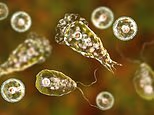
A teenager has been hospitalized and is in a ‘critical condition’ after contracting a rare brain-eating amoeba while swimming in fresh water.
The patient is inside North Carolina and was infected with Naegleria fowleri, a single-celled organism found in fresh water that travels through the nose to the brain.
Health officials in the state, who disclosed the case, have not yet confirmed the source but are urging all residents to take extra caution before swimming in ponds, lakes or rivers.
In a news release, they said the teen “is seriously ill and is receiving medical care.”
No further details were revealed, including the patient’s name or where in the state he or she is located, which officials said was intended to protect their privacy.
N. fowleri is naturally present in freshwater ponds, lakes and rivers and increases in numbers during the summer months, when water temperatures can exceed 115 degrees Fahrenheit.
The amoeba does not cause disease if swallowed, but can be fatal if water containing the amoeba is forced through the nose, which can be caused by jumping or diving in fresh water or by water sports and activities.
There is a greater risk of infection if water is warm for a long timeallowing the organism to multiply rapidly. According to health officials, male children and teenagers are at the greatest risk of infection.
Above is a stock photo of the amoeba Naegleria fowleri that causes the infection
Infections are rare; currently, approximately three infections are recorded annually in the US.
The North Carolina case marks the second nationally recorded case this year, after a child in Louisiana, Lillian Smart, died of the amoeba shortly after her eighth birthday.
It is also the first case in North Carolina since 2019, when a teenager was also infected. The state also recorded a case in 2016, when a student died from an infection he contracted after capsizing a raft.
Dr. Zack Moore, the state’s epidemiologist, said in a statement: “Our thoughts are with this teen’s family, friends and loved ones as they navigate this difficult time.
“While these infections are very rare, this is an important reminder that this amoeba is present in our state and across the US.
‘There are steps people can take to reduce the risk of infection when swimming during the warmer months.’
The symptoms of the infection start with a severe headache, fever, nausea and vomiting, progressing to a stiff neck, seizures and coma.
The disease progresses rapidly, with many patients dying within five days. The mortality rate is over 97 percent.
Lillian Smart succumbed to amebic meningoencephalitis on Saturday, just one day after her eighth birthday
It causes a condition called primary amebic meningoencephalitis, or inflammation of the brain and surrounding area.
Treatment involves a cocktail of medications to eliminate the pathogen and reduce swelling.
There are several ways to reduce the risk of contracting the amoeba when jumping or swimming in fresh water.
These include; holding your nose or using a nose clip, keeping your head above water, avoiding immersing your head in hot springs and thermal waters, not jumping or diving into fresh water during hot periods, and avoiding digging up or stirring the sediment of fresh water while participating in water-related activities.
For Smart, she died from the amoeba just one day after her eighth birthday, her parents said in a heartbreaking post on Facebook.
She became infected after swimming in Lake Claiborne in Louisiana.
“Last night Lillian ran from our arms to the arms of Jesus,” the girl’s parents wrote. “The injuries to her brain were too severe for her tiny body to recover from.”
“Everyone has done everything they can to keep her here,” the parents continued, noting that they are “heartbroken and honestly don’t know what to do next.”
“How can we put one foot in front of the other without our girl?”