A popular food product produced in a celebrity-favorite enclave in the Hamptons and sold nationwide is being recalled amid fears it could be contaminated with a deadly bacteria.
The Hampton Grocer, Inc. of Montauk, New York, is recalling its Lacnola Lactation Granola in 8-ounce bags due to concerns that the product may be contaminated with salmonella, a bacteria that can cause a life-threatening illness.
The to remind The reason for this was that an ingredient used in the product supplied to The Hampton Grocer was itself involved in a separate recall.
That recalled ingredient is organic moringa powder supplied by Food to Live.
The recall applies to all Lacnola products sold or distributed since October 23, 2025. They were available for purchase through the company’s website and other online retailers, including Amazon.
The company posted on its Instagram: ‘At this time, neither Lacnola nor the specific moringa powder used to make it have tested positive for Salmonella. No illnesses have been reported associated with Lacnola or the recalled Food to Live products.
“We are taking this action out of an abundance of caution. As soon as we were made aware of this, we stopped selling Lacnola on all platforms and hit pause on the product.”
There will be no impact on other products made or sold by The Hampton Grocer.
The Hampton Grocer, Inc. of Montauk, New York, is recalling its Lacnola Lactation Granola in 8-ounce bags
The recalled products have expiration dates of October 21, 2026 and February 13, 2027. The affected lots are HGLC-102125 and HGLC-021326 and the Universal Product Code (UPC) is 850035324554
Consumers are urged not to eat the granola, request a refund from The Hampton Grocer and throw the product away.
Food To Live originally recalled its moringa powder earlier this month, along with several other products, because it could potentially be contaminated with Salmonella.
The recall was initiated after the FDA notified the company that a sample of its Organic Supergreens Mix tested positive for salmonella.
The source of the contamination has not been confirmed.
Salmonella can cause diarrhea, fever, stomach cramps and dehydration – symptoms that require medical attention, especially in children under five, adults over 65 and people with weakened immune systems.
The CDC estimates that Salmonella causes approximately 1.35 million infections, 26,500 hospitalizations and 420 deaths annually in the US.
Although most cases resolve with supportive care – mainly hydration and rest – the bacteria’s ability to survive stomach acid and invade intestinal cells makes it a potent pathogen.
In severe cases, the infection can escalate beyond the gastrointestinal tract.
When Salmonella enters the bloodstream, a condition known as bacteremia, it can spread to other parts of the body and cause secondary infections.
These may include endocarditis or infection of the heart valves; osteomyelitis or bone infection; meningitis, or an infection of the membranes surrounding the brain and spinal cord; or septic arthritis, a joint infection.
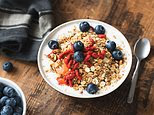
The granola recall was initiated because an ingredient used in the product supplied to The Hampton Grocer was itself involved in a separate recall (stock image)
These invasive infections are particularly dangerous and require prompt treatment with antibiotics, often administered intravenously in a hospital setting.
Invasive salmonellosis can also lead to long-term complications even after the initial infection has cleared.
Some people develop reactive arthritis, a condition characterized by joint pain, eye inflammation, and painful urination that can last for months or even years.
Others may suffer from post-infectious irritable bowel syndrome (IBS), with chronic digestive problems due to the damage caused by bacteria to the intestinal lining during the acute phase of the disease.
Salmonella is resilient. It can survive on surfaces for weeks and is resistant to certain environmental factors, making it difficult to completely remove it from food production facilities.
Because contaminated food looks, smells and tastes completely normal, the only way to protect consumers is to remove it from the supply chain before it can be eaten.