The idea of someone hacking a plane in less than a minute might sound like the plot of an unrealistic Hollywood blockbuster.
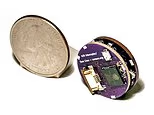
But a terrifying new study has revealed how this can be achieved, using a device the size of a 10 cent coin.
Scientists from the University of California San Diego has developed a custom hardware device that can take over communications between two important onboard computers.
One computer is the flight management computer, the other is the computer that displays this flight path information in the cockpit.
To take over these crucial systems, hackers simply need to connect the device to a port in the belly of the aircraft.
According to the researchers, such an attack would take less than 60 seconds to carry out on a Boeing 737 parked at a gate or in an airport hangar.
“We believe we have strongly demonstrated that time-limited physical access (e.g., 60 seconds) is a realistic goal for a motivated attacker,” the researchers said.
“The consequences of even such brief access can be significant (and therefore worth paying attention to).”
The idea of someone hacking a plane in less than a minute might sound like the plot of an unrealistic Hollywood blockbuster. But a terrifying new study has revealed how this can be achieved, using a device the size of a 10 cent coin
Typically, physical access to an aircraft is not considered a major cybersecurity risk.
In their new research, however, the team wanted to understand whether an attacker with physical access to an aircraft could exploit its systems.
“Our goal with this study is to alert the aviation community to this class of hazards so that they can be appropriately mitigated before they become dangerous,” said Aaron Schulman, one of the senior authors of the work.
While studying a Boeing 737, the team discovered an unused maintenance port in the aircraft’s Electronics and Equipment (E&E) room, which houses key avionics systems.
The bay is located under the nose of the aircraft – and crucially it can be reached from the ground and is not closed off.
“What we discovered in our work is that there is a plug deep in the E&E room that, if you open the door and go in, you can touch it from the ground,” Mr. Schulman explains.
“And when you attach something to that plug, you actually get full control over the entire flight management computer.”
This port contains two ‘buses’: communications systems that transfer information and instructions between the flight management computer and the computer that displays the flight route information.
Scientists at the University of California, San Diego, have developed a custom hardware device that can take over communications between two important onboard computers. One computer is the flight management computer, the other is the computer that displays this flight path information in the cockpit
While studying a Boeing 737, the team discovered an unused maintenance port in the aircraft’s Electronics and Equipment (E&E) room, which houses key avionics systems. The bay is under the nose of the aircraft – and crucially it can be reached from the ground and is not locked
These buses, called ARINC 429, run on decades-old systems – and lack any modern security features.
For that reason, it was quite easy for the researchers to design and build a small hardware device to take over the buses.
Simply put, the device emits a strong signal that can overpower real transmissions.
This allows it to secretly send new instructions to the plane’s computers, while hiding the fact that anything has changed.
During a demonstration, the team showed that the implant could divert an aircraft in flight, or change important data about weight, balance and temperature – leading to an unsafe takeoff.
“The pilot has no idea anything is going on,” Schulman said.
“So it’s a very secretive and stealthy form of control that you can have with these types of attacks.”
The researchers decided to focus on the Boeing 737 because it is one of the most widely used aircraft in the world.
But before you start panicking about your next vacation, the researchers assure that their hacking device remains under lock and key.
Mr Schulman added: ‘All authors of this article routinely travel on Boeing 737 aircraft and expect to continue to do so.’