Syria’s court on Tuesday handed down a death sentence to detainee Wassim al-Assad, a cousin of the longtime ruler Bashar al-Assad.
Judge Fakhr al-Din al-Aryan said that Wassim al-Assad had been convicted of multiple murders and “murder involving torture and cruelty… classified as crimes against humanity and war crimes‘, adding that ‘he was therefore sentenced to death’.
Wassim al-Assad faced a series of charges, including setting up and leading paramilitary groups since 2011.
He was also accused of participating in military operations targeting civilians in Eastern Ghouta, which resulted in the deaths of ordinary Syrian civilians.
He is the first member of the al-Assad family to be personally convicted.
His sentence comes just a week after the brutal dictator himself was sentenced to death in absentia for crimes against humanity.
Bashar al-Assad and his brother Maher al-Assad have both been convicted in absentia because they live in exile in Russia.
Judge Fakhr al-Din al-Aryan, who also oversaw the dictator’s case, said Bashar’used government agencies to commit war crimes and crimes against humanity.’
A Syrian court has sentenced former ruler Bashar al-Assad to death in absentia
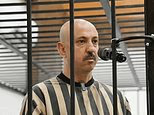
Judge Fakhr al-Din al-Aryan said Wassim al-Assad (pictured) had been convicted of multiple murders and ‘murder accompanied by torture and cruelty’
The same case also sentenced to death Assad’s maternal cousin, Atef Najib, who was convicted of overseeing a deadly crackdown in the southern province of Daraa that led to the uprising and later the civil war.
Amid tight security, Najib stood in a cage, dressed in a prisoner’s uniform, as the judge read out the verdict. A crowd of people gathered outside the courthouse in central Damascus to hear the verdict.
Assad and his brother Maher fled to Russia after the fall of the government 20 months ago and were granted political asylum. Syria’s new rulers have asked Russia to extradite the Assads.
Najib, who was sanctioned by the US Treasury Department in April 2011, was later detained in rural Latakia, northwestern Syria, and is one of the highest-ranking officials on trial.
Najib is a former brigadier general of the Syrian army who headed the Political Security Department in the southern Syrian province of Daraa in 2011 under Assad.
During his tenure, more than a dozen teenagers who scribbled anti-government graffiti on a school wall in Daraa were arrested and tortured. The case became a catalyst for mass protests against the repressive policies of Assad’s security forces.
The protests were met by brutal government action and culminated in a 14-year civil war that ended with Assad’s ouster in a lightning rebel offensive.
Maher Assad was a former commander of the Syrian Army’s 4th Armored Division, who is accused by Syrian opposition activists of killings, torture, extortion and drug trafficking, in addition to running his own detention centers.
The court sentenced six former military and security officials to death in absentia. Those convicted included former Defense Minister Fahd al-Freij and Louay al-Ali, who headed military intelligence in Daraa province in 2011.
People view damage at the site of a Syrian regime air force strike that targeted a neighborhood in Syria’s rebel-held northern city of Idlib on December 1, 2024.
A member of security forces loyal to Syria’s interim government guards a checkpoint previously occupied by supporters of deposed President Bashar al-Assad in the town of Ayn Shiqaq, coastal Latakia province, on March 11, 2025.
Al-Assad, whose brutal treatment of his compatriots earned him the nickname “The Butcher,” fled Syria when he was overthrown in December 2024 by a collection of rebels led by Hay’at Tahrir al-Sham (HTS), whose leader Abu Mohammad al-Julani is now the country’s president.
Under al-Assad’s rule, Syrian government forces have killed civilians en masse as part of their strategy to defend against the civil war that decimated the country between 2011 and December 2024.
The government is believed to be responsible for the deaths of 90 percent of the more than 300,000 civilians estimated to have died during that period.
Between 2011 and 2023, another 154,000 people were forcibly disappeared or arbitrarily detained by government forces, while more than 135,000 people, including women and children, were tortured, imprisoned or murdered in Ba’athist prison networks.
But Mr al-Assad is perhaps most notorious for his forces’ use of chemical weapons during the civil war. According to a study by the Global Public Policy Institute, pro-Assad forces carried out approximately 330 chemical attacks between 2012 and 2019.
The most commonly used chemical was chlorine gas, although Sarin gas and sulfur mustard were also used. Under international law, all three cannot be used in war.
Stephen Rapp, the former US ambassador for war crimes issues, said in 2014 after the release of evidence of torture under the Assad regime: “This is… the kind of machinery of brutal death that, frankly, we haven’t seen since the Nazis.”
He added at the time: ‘If it is what it seems so far, we are talking about more than 10,000 persons murdered in custody in the period from 2011 to 2013, largely men, but also some very, very young men, boys and women… It is shocking to me as a prosecutor. I’m used to the evidence not being that strong.”
Armed groups opposing the Assad regime seized control of Aleppo on November 30, 2024
Images of Assad wearing Speedos sparked mockery on social media after the fall of his regime
The fall of the Assad regime in Syria was widely seen as a great embarrassment for Putin, who sheltered him
The civil war also caused the exodus of 6.6 million people from the country, all of whom fled in fear for their lives.
These refugees contributed to the European migrant crisis that dominated the mid-2010s. UNHCR, the UN refugee agency, received almost a million asylum applications in Europe in August 2017.
Many European countries also had to temporarily accommodate large numbers of refugees. Turkey was the largest host country, hosting 3.3 million Syrian refugees in 2023.
It is now believed that the deposed ruler is too live in three apartments in a luxury high-rise with a shopping center downstairs in Moscow to his former ally Vladimir Putin deported him and his family from the country.
Since fleeing, he has taken up his old job as an ophthalmologist – a role he had trained for as a young man in London – to treat the Russian capital’s elite.
A family friend told The Guardian in 2025, a year after he was ousted: “He is studying Russian and brushing up on his ophthalmology.
‘It’s a passion of his, he clearly doesn’t need the money. Even before the war in Syria started, he regularly practiced his ophthalmology in Damascus.
He trained in ophthalmology in London in the early 1990s, but was called back to his home country after the unexpected death of his brother in a car accident in 1994.
Shortly afterwards, he entered the military academy and became the regime’s heir apparent.
Now he spends much of his time playing online video games, despite being allowed to move freely around Moscow and his country villa outside the Russian capital.
Exiled Syrian ruler Bashar al-Assad reportedly spends his days playing video games in his luxury Moscow apartment
A car burns after clashes between the new Syrian authorities and supporters of deposed President Bashar al-Assad near the city of Jableh in the coastal province of Latakia on March 10, 2025
A general view shows hundreds of people gathered in Al-Assi Square during celebrations marking one year since the city’s liberation, in Hama, Syria, December 5, 2025
He has been given bodyguards by a private security company, paid for by the Russian government.
The friend said he now lives ‘a very quiet life’, adding: ‘He has very little or no contact with the outside world. He only has contact with a few people who were in his palace, such as Mansour Azzam [former Syrian minister of presidency affairs] and Yassar Ibrahim [Assad’s top economic crony].’
Part of this stems from Putin’s apparent dismissal of Mr al-Assad after the fall of the regime in Syria.
A source close to the Kremlin told the newspaper: “Putin has little patience for leaders who lose their grip on power, and Assad is no longer seen as an influential figure or even an interesting guest to invite to dinner.”
In April, Atef Najib, al-Assad’s cousin who was also sentenced to death, said was paraded in a cage wearing a striped prison uniform while on trial, accused of mass shootings and torturing children.
He was seen sitting on the corner of a wooden bench as hordes of people filmed and photographed him through the metal bars of the Central Palace of Justice in Damascus.
In February 2011, he ordered the arrest of perpetrators who defaced walls in the city of Daraa and called for the end of the regime.
Police have arrested two teenage boys after discovering their names scrawled next to the offensive graffiti sprayed on a wall outside their school.
The teenagers were tortured and beaten during their captivity until the real perpetrators, aged between 18 and 30, confessed.
Atef Najib, dressed in a striped prison uniform, sat apparently emotionless in a cage in a courtroom in the Central Palace of Justice, in the Syrian capital Damascus, last week
In one photo found after the fall of the regime, Assad is seen wearing nothing but white pants and a vest, clearly posing for the camera
A photo showing Syrian President Bashar al-Assad was taken by rebels after the capture of his palace in Aleppo
The treatment of the schoolboys, under Najib’s command, sparked further demonstrations, which led to police shooting at protesters and killing several people on March 18.
In April 2011, a strange teenage boy named Hamza al-Khateeb disappeared after a protest. The body of the 13-year-old boy was returned to his parents, badly mutilated.
After the atrocities, Najib was removed from his role by Assad and branded as the ‘Butcher’ for killing his own people. However, he was reinstated to the same role in the northwestern province of Idlib.
Security forces’ crackdown on peaceful pro-democracy protests led to the civil war, which killed more than half a million people and displaced millions more.
As the civil war continued for thirteen years, Najib became increasingly sidelined by the regime.
He remained in Damascus after Assad fled the country in December 2024, following the overthrow of the government by rebels, and was arrested in January 2025.