The warning signs of sudden adult death syndrome have come into sharp focus after the son of Manchester United legend Mark Hughes died from the rare condition.
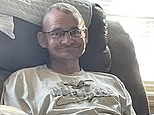
Alex Hughes, 38, collapsed on the floor of his bedroom where he was found by his two sons on June 19, an inquest heard this week.
The condition – now medically known as sudden arrhythmic death syndrome or SADS – is believed to be the cause of his death.
SADS is the term for when someone dies unexpectedly from cardiac arrest, where the heart suddenly stops pumping blood through the body.
The condition can kill fit and healthy people – usually under the age of 35 – and is the cause of death of around 500 to 800 people in Britain every year.
However, many of the victims have no signs of having had a heart problem after their death.
Coroner Victoria Davies said this week that Mr Hughes had suffered a ‘sudden death with a normal heart’.
Over time, experts have outlined some of the key conditions responsible for SADS – and the warning signs that thousands of Brits may need to look out for.
Alex Hughes’ cause of death is believed to be sudden adult death syndrome, also known as sudden arrhythmic death syndrome or SADS.
According to charity Cardiac Risk in the Young (CRY), the conditions responsible for SADS cause cardiac arrest because they disrupt the heart rhythm. This is medically known as ventricular arrhythmia.
The experts say this can happen even in people who have never had structural heart disease – the umbrella term for various heart defects, including holes and damage.
Often the trigger for SADS is a group of rare diseases known as ion channelopathies – rare genetic conditions, usually inherited from parents.
These affect the electrical functioning of the heart, without changing the structure of the organ.
The electrical function of the heart affects its rhythm – how fast it beats – but stops after death.
According to the British Heart Foundation (BHF), this is one of the main reasons why the cause of cardiac arrest is difficult to identify, and why SADS can be attributed to a person’s death.
These ion channelopathies are believed to be the cause of approximately 40 percent of SADS deaths.
And CRY says there are four in particular to look out for.
The first is Long QT Syndrome (LQTS), which they say is the “most common and best understood type.”
LQTS affects around one in 2,000 people, meaning around 30,000 Britons could have the condition.
According to the NHS, LQTS can cause palpitations, the term for when the heart beats irregularly or faster than normal.
People with LQTS may be at risk of seizures or fainting and are at risk of cardiac arrest if this does not stop.
Usually people who die from the condition do so in their sleep.
The health care system says about half of LQTS patients don’t even have symptoms.
However, it can be discovered with an electrocardiogram (ECG) – a test of the heart rhythm.
People with the condition are urged to eat foods rich in potassium, such as bananas, to stay hydrated, avoid sudden noises such as alarm signals and to manage stress levels and anxiety.
They are told not to do difficult exercises and to avoid drinks that contain high amounts of caffeine.
The second channelopathy that you should take into account according to CRY is Brugada syndrome.
NHS guidelines say around one in 5,000 people in England have the condition, which, like LQTS, is hereditary, often asymptomatic and can be detected with an ECG.
However, some symptoms – if any – may be slightly different.
In addition to the risk of fainting, palpitations and cardiac arrest, patients with Brugada syndrome may also feel dizzy and experience shortness of breath.
Patients are also likely to die from the condition in their sleep.
Patients with Brugada syndrome are urged to consult a doctor before taking any medication, but they are told to take paracetamol or ibuprofen if they feel unwell to avoid high fever, as this can cause problems with heart rhythm.
Staying hydrated is also important.
They are told not to drink alcohol excessively and to avoid strenuous exercise.
The third high-risk condition is catecholaminergic polymorphic ventricular tachycardia (CPVT), which affects around one in 10,000 Britons.
CPVT, which is also caused by genetics passed down from parents, has much of the same symptoms as LQTS and Brugada syndrome. They often appear in childhood.
It is said to be difficult to detect because patients are sometimes misdiagnosed with epilepsy.
According to the BHF, a CPVT patient’s heart rate is usually accelerated by emotional or physical stress.
Those experiencing symptoms will also receive an ECG and some will be given a 24-hour heart monitor.
The final channelopathy associated with SADS is progressive cardiac conduction defect (PCCD).
It is not known how many Britons may be living with the condition.
PCCD typically causes the heart to beat ‘very slowly’, according to the BHF, which says this means electrical signals ‘cannot travel through your heart properly’.
This can lead to cardiac arrest, because there is not enough blood flowing through the body.
PCCD can also cause dangerously fast heart rhythms. Shortness of breath, dizziness, fainting and blackout are also warning signs.
That said, the BHF explains that many people with the condition – also known as Lev-Lenegre syndrome – ‘live normal lives’.
These four conditions are thought to account for the majority of SADS deaths, while structural heart disease causes only 10 to 20 percent.
Examples of these structural changes include hypertrophic cardiomyopathy – when the heart muscle is abnormally thick – and dilated cardiomyopathy, the term for when the heart chambers become stretched.
Arrhythmogenic right ventricular cardiomyopathy – when the heart muscle cells do not stick together properly – is also thought to be a cause.
CRY says: ‘In some cases the pathologist cannot confirm the diagnosis of structural heart disease – because there is no evidence for it, or because there is not enough evidence and the heart is perceived as relatively normal. The death is therefore registered as SADS.
‘This can happen even in cases where evidence of hereditary structural heart disease is subsequently discovered in other members of the victim’s family.
‘However, the presence of very subtle structural heart disease in the victim may have been sufficient to cause sudden cardiac death.’
It is believed that SIDS – the sudden death of a baby – may be partly due to the same causes responsible for SADS.